Monday, 17 January 2022

1919 Holiday at Bribie

 1919 First two weeks of January

Holiday at Bribie

On Wednesday 1 January 1919, Elsie Jones (19) and her aunt Ivy Campbell (21) were staying at Toorbul and went across to Bribie Island to see the Beaver arrive and wave goodbye to one particular passenger returning to Brisbane. These details are recounted by Elsie in her diary which has been kindly shared with BIHS by her family.

For Elsie and Ivy, 1st January was a public holiday known as Commonwealth Day. They had travelled from Brisbane to Toorbul on the previous day and may have attended the concert that was held on Bribie on New Year's Eve.

The concert on Bribie had been arranged by a committee comprising Messrs. R. Davies, H. McLeure, T. Marshall, T. Carberry, F. Brockley and P. Daunt (chairman) and Miss Ackworth (pianist), for the benefit of the Ambulance Brigade and the St John's Ambulance. A newspaper article reported that 400 people attended the concert, the majority of whom were campers staying on Bribie Island for the holidays.


QUEENIE  JONES  DIARY  1919 JANUARY

1 WEDNESDAY        Commonwealth Day – Public Holiday
Ivy & I landed at Toorbul yesterday.  All of us went over to Bribie in motorboat in morning to see the “Beaver” in, & to see Pte. Davis off.  In afternoon Ivy & I took books up into a tree on the beach – scrumptious.  Then had a yarn (revelations) to Miss Shepherd, & came to bed straight after tea.  Scrummy day!

2 THURSDAY
Went over to Bribie again today.  Met Mrs. Dickson & had lunch there.  In afternoon, Ivy & I went up into tree on beach & wrote poetry!  People next door put telescope on us & also camera.  Miss Shep., Ivy & I walked on jetty at night.

3 FRIDAY
In morning, Miss Shep., Jack S., Ivy & I fished out in rowing boat, then in afternoon, we three girls drove over to a fruit farm, had tea & bought fruit.  Slept & read for a few hours at midday & had a walk on jetty at night.

4 SATURDAY
All the party of us went up the Channel about twelve miles, had lunch on Bribie, stayed a few hours & came home about 4.30 p.m..  Read till night.  Got a letter from Mum.

5 SUNDAY
Went over to Bribie again, & then read all afternoon.

6 MONDAY
A party of us all went up to Caloundra by motor boat (30 miles).  Had a lovely walk along beach, collected shells, climbed rocks, etc..  At night slept in a tent, cows walked on us, etc..  Heavenly day.

7 TUESDAY
Went up to Mrs. King’s Boarding House & met Mrs. Dickson & Oliver & spent morning on cliffs with them.  Came back from Caloundra in afternoon in boat.  I wrote a letter.  Pte. Davis came back.

8 WEDNESDAY
We three sat in tree on beach in morning & talked.  In afternoon we read & talked to Alick (Pte. D. I mean!).  At night he played accordion & then gramophone to us.  I got a home letter.

9 THURSDAY
Looked through Cottage in morning.  Then all went over to Bribie in launch, & met Mrs. Jubb there.  Doctors went home!  We read all the afternoon & had an argument at night – Miss. Shep. v. Alick Davis.

10 FRIDAY
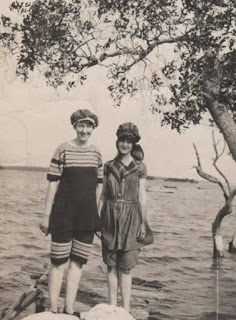
Read all the morning, and Ivy slept.  In afternoon the three of us took a walk into the bush and read.  Then had a bonser bathe.  Had a walk & some music at night.
"Bonser" bathing belles - Elsie and Ivy
Photo from Jones Family collection.

11 SATURDAY
Read a whole book this morning – “Delphina”.  In afternoon, Miss Shep, Ivy & I drove about six miles & went to see Mrs. Hill & son.  Got home about dark.  Moonlight on jetty!

12 SUNDAY
Saw Miss Shep. off at Bribie.  At night, sat on jetty, then Alick told us his WAR experiences.

13 MONDAY
All went round Skirmish Point on Bribie per launch for picnic.  Then Mr. Bar., Mrs. Bick (?), Alick, Ivy & I had a four miles walk round beach.  Had a glorious time.  Ivy & I had walk on jetty at night, tide in & moonlight, then a talk on verandah.

14 TUESDAY
Packed in morning & Mr. Davis brought us over to “Koopa”, where we met Harold B. who took us up ‘aloft’.  Met Spurgins at Redcliffe & all came home together.  A storm & she rocked some!  Lost luggage, & I came home on 8 train & waited for Ivy till 10 p.m..


Elsie 'Queenie' Jones at Toorbul Point, 1919
Photo from Jones Family collection.


Ivy Campbell on holiday at Toorbul Point, 1919
Photo from Jones Family collection.


ACKNOWLEDGEMENT

We thank Claire Wilson and the Jones family for allowing the use of diary entries and their photos.


REFERENCES

The Holiday at Bribie. Concert for Ambulance Funds.
The Telegraph (Brisbane) Sat 4 Jan 1919 p.2 http://nla.gov.au/nla.news-article176307074
A very enjoyable time has been spent by the campers at Bribie Island, and through the energy of a committee comprising Messrs. R. Davies, H. McLeure, T. Marshall, T. Carberry, F. Brockley and P. Daunt (chairman) and Miss Ackworth (pianist), a concert was held on Tuesday 31st December from the veranda of Mr Leeder's house, for the benefit of the Ambulance Brigade and the St. John's Ambulance. The audience numbered about 400 people. Mr Leeder was kind enough to place at the disposal of the committee his piano and house, and also donated a Christmas cake and 6 dozen oysters, to be disposed of.... 

Jones, Queenie (Elsie Llewella) & Cook, Margaret & Pullar, Helen (2005). Queenie's diary : a schoolgirl's life : 1914-1915. Agneau Press, Bellbird Park, Qld.
https://trove.nla.gov.au/work/14798005?keyword=%22queenie%27s%20diary%22

FURTHER READING

1919 Bribie Island -- The Rising Resort
http://bribieislandhistory.blogspot.com/2022/01/1919bribieislandtherisingresort.html

The Apiary.
Brisbane Courier 31.10.1914 p.13 http://nla.gov.au/nla.news-article19993020
Mr H.L. Jones presided at a committee meeting of the Queensland Beekeepers' Association ... A communication was received from Mr A.N.J. Hill [Toorbul] ... "... the best friend of the orchardist - the bees" ...

Monday, 10 January 2022

1919 Bribie Island The Rising Resort

1919 Bribie Island ... The Rising Resort

Bribie Island, or Bribie as it is more conveniently called, is reached by continuing the steamer trip in the steamer Koopa past Redcliffe to its furthest limits.  It is some 38 miles from Brisbane, and is reached after a three hours’ run from the city, the steamer berthing at a short, well-constructed jetty.  It and Moreton Island, which lies opposite at a considerable distance, form the most northern outposts of Moreton Bay.  Bribie Island about 20 miles long, from 2 to 3 miles broad, and is well timbered.  ....

The landing place is at Bongaree, on the calm inner beach of the island.  The Brisbane Tug Company have formed a road of about three miles to the main ocean beach, where surf bathing can be enjoyed.  Later on it is intended to construct a tramway thereto.

Near the jetty there is a commodious refreshment-room, where fish and oyster dinners are obtainable, and also two stores at which campers can purchase necessities.  A large pavilion, bathing sheds, and other conveniences for the use of visitors have been erected.  Accommodation is provided for by three boarding-houses, and as a further inducement, the steamship company has erected some twelve or more huts of a standard design and size (about 14 feet by 12 feet) along the inner beach.  On application to the caretaker, Bribie, these may be let at the following rates:- Ordinary weekly tariff, 6s; Christmas, New Year, and Easter, 10s per week; week-ends 3s 5d.  There are also several furnished cottages, which may be rented periodically.  

Campers and picnickers are assured of an ample supply of fresh water, large tanks having been erected by the company for that purpose.  As a proof of the increasing popularity of this resort it may be mentioned that during the recent holidays fully 1000 campers, apart from other visitors, were located here, and had further accommodation been available it goes without saying that this number would nearly have doubled itself.

For the excellence of its fish and oysters, Bribie is known far and wide, and during the summer months it is the intention of the company to run their steamer to Bribie every alternate Saturday at 2 p.m., thus affording city folk and anglers an opportunity of a week-end at this resort.

Advertisement from Telegraph 3 Jan 1919 p.5

Whole day trips are now made to Bribie (calling at Redcliffe both ways) on Tuesdays, Thursdays, and Sundays, leaving Kennedy Wharf at 9.30 a.m. and returning at 6 p.m.  Passengers are allowed 2 hours ashore on these trips.

Splendid motor boat trips may be taken northward through the picturesque Pumice Stone Channel, on the inner side of the Island, to Caloundra, a distance approximately, of about 28 miles.  Arrangements for this trip can be made by first communication with Mr A. Bestman, of Bribie, who also keeps a motor car for hire.  By this latter means tourists are enabled to enjoy a trip along the hard sand of the outer beach, and, when the ferrying arrangements at the northern end are completed, the journey to Caloundra may be completed almost wholly by motor car.

Visitors at Caloundra can also make arrangements through Mr A. Tripcony for their conveyance by motor boat through the Pumice Stone Channel to Bribie, connecting with the steamship Koopa for Brisbane. ...

REFERENCES   

Bribie Island -- The Rising Resort
Daily Standard (Brisbane) Sat 4 Jan 1919, p. 5 http://nla.gov.au/nla.news-article179818787 

Redcliffe, Bribie and Dunwich Bay Excursions from Kennedy Wharf [advertisement]
Telegraph (Brisbane) Fri 3 Jan 1919 p.5 http://nla.gov.au/nla.news-article176300901

Thursday, 11 November 2021

Reed baskets handmade in the 1950s

 "Old Tom's" reed baskets 
handmade in the 1950s 
on Bribie Island

In the late 1950s "Old Tom" Pethers used to make baskets out of reeds with tin bases. Recent memories from the Lind family recalled Old Tom and his baskets and remarkably two of his baskets are still used today!


ACKNOWLEDGEMENTS    

Thank you to the Lind family for sharing their memories.

Photographs by Sue Edwards.

Monday, 25 October 2021

Trip to Bribie Island in 1916

 The following article was published in 1916.

A TRIP TO BRIBIE ISLAND (1916)

Walter J. May

Several islands are situated in Moreton Bay, at the entrance to the Brisbane River, and on one of these — Bribie Island - the writer, with a few friends, spent a very enjoyable week end a short time ago.  

Bribie Island is infested with snakes, and we could not help admiring the beautiful markings of a carpet snake, between five and six feet long, which had been despatched by one of our party, who, noticing a tremendous bulge in its body, cut it open, when out tumbled a fowl  !  

We were able to indulge in some very fine bathes in the calm water, and, the water being warm, we were able to stay in for hours ; but felt very thankful that no untoward incident occurred to spoil our enjoyment.  

A shark, we were afterwards told, had been caught a few days previously, and two large iguanas were found in its stomach. This shows that iguanas must be in the habit of swimming from the island to the mainland — a distance of one mile.  

Another interesting episode occurred whilst returning in a motor-boat, along the channel to Bribie Island. Something was noticed swimming in the water. All eyes were riveted on the object ; what could it be?  On closer investigation it proved to be a wallaby. The boat was stopped, and the wallaby taken on board, but it evidently objected to be rescued, and, jumping overboard, continued swimming to the mainland ; this being the first occasion that I have seen recorded of a wallaby swimming.  

Looking North up the Passage from the Pier.
Photo: N. Langdon
Queensland Pictorial, Supplement to The Queenslander 1 Jan 1916


Towards dusk, a series of long-drawn-out howls were heard, and soon afterwards an animal was seen approaching through the scrub. When it saw us, it retreated, but we could see through the bushes the yellow coat of what must have been a dingo.  

The fishing here was not too good ; perhaps we did not fix upon the right spots. One of us caught twelve fish, but as they were all catfish our larder was not replenished thereby.  

Mosquitoes proved a great trouble, as they were present in clouds and annoyed us a good deal. On the whole, we had an enjoyable outing, the pleasant bathing being, perhaps, one of the most enjoyable incidents of our stay at Bribie Island.  

WALTER J. MAY.  

REFERENCES

May, Walter J. (1916) A Trip to Bribie Island. The school magazine of literature for our boys and girls / the Department of Education, New South Wales, v.1(8) September 2, 1916, page 127. 

1916 Scenes on Bribie by N Langdon. BIHS Blogspot post Sep 2018

Scenes on Bribie. The Queenslander 1 January 1916, page 22. To access a high resolution copy of page 22, go to State Library of Queensland's online catalogue at:  Queensland Pictorial, Supplement to The Queenslander 1 Jan 1916 

Thursday, 16 September 2021

Bribie in Bloom

Springtime on Bribie is a lovely time now and has been in the past as can be seen by these two articles and photo. 

Bribie in Bloom in the 1920s and 1930s

Bribie in Bloom (1928)

In spite of human settlement, Bribie Island is still very much as Nature made it. The spring weather and warm sunshine of the past two or three weeks have transformed it into a wild garden in which the sombre green of pine trees blends with scarlet gum-tips, wattle, and white-flowering shrubs. 

To drive across the island is a delight, for the air is sweet with perfume, and the landscape is a picture. In remote places the beautiful boronia may be found in abundance - "more than the whole of Brisbane could pick," as a resident said, last Sunday - and everywhere colour leaps before the eye in vivid tones. 

There are probably few places within easy reach of the city where the nature-lover can so enjoy himself. This is the most astonishing when it is remembered that practically the whole island is composed of sand.

                                                         reference: The Brisbane Courier Tue 21.8.1928 p. 12 


Boronia from Bribie.
The Queensland Naturalists' Club held an exhibition
of wildflowers in Albert Hall. Miss D. Williams is shown
arranging a vase of Boronia from Bribie Island.

                                                    reference: The Telegraph 1.9.1934 p. 1 

Letters from Little Readers (1932)

I have just returned home from a holiday at Bribie Island; had a royal time, too. Have you ever been to Bribie, Aunt? The island looked very pretty ; it was covered with wildflowers. There were some pretty bushes all out in white flowers : people down there called them bridal bushes. I liked those the best. I do not think I had ever eaten so many fish before in all my life. We had fish for breakfast, dinner and tea. I did not try my hand at fishing, though ! 

The house I stayed at was just off the Ocean beach. I was down for a fortnight, and only went in surfing once, and that was on a dull day. If I go in on a sunny day I get sunburnt and blistered, and have to put up with sore back and shoulders. I do not think there is much fun in that, do you?

One afternoon I walked along the beach for miles, and picked up some pretty shells and seaweed. I filled up most of the time reading and sewing. I worked on an apron. Coming back to Redcliffe the sea was rough ; some of the people were seasick, but I was not. ... "Baby Mine" (15) Palmwoods.

reference: The Queenslander Thu 3.11.1932 p. 40 

REFERENCES

Bribie in Bloom. The Brisbane Courier 21.8.1928 p. 12
http://nla.gov.au/nla.news-article21319413

Letter from Little Readers. The Queenslander 3.11.1932 p. 40 
http://nla.gov.au/nla.news-article23153429

Boronia from Bribie. [photo] The Telegraph 1.9.1934 p. 1
http://nla.gov.au/nla.news-article181374258

Friday, 6 August 2021

1944 Big Bird

The following article was written by Ken Telfer (1924-2018) and provides us with a wonderful glimpse of a day in 1944 when an aircraft landed on Toorbul Point and amazingly took off again the next day.

Thank you Ken.

The Day the Big Bird Came to Toorbul Point

by Ken Telfer, ex-Sapper, 2 AWT Group

 Big Bird by Ken Telfer, ex-Sapper, 2 AWT Group. 
Log Book no. 58, April 1991 pages 10-12.**

"Well, not a real big bird like today's Jumbo jets, but still a sizeable airliner for the late thirties and forties.

In early 1944, the Training Centre moved from Chowder Bay to Toorbul Point and that's where the story starts. When we arrived the United States Navy was still in residence at the main base down on Pumicestone Passage. Accordingly, personnel of the AWT Training Centre were encamped up on the cliffs overlooking Deception Bay, where Pebble Beach Housing development (of the late 1980s) is now situated.

Our campsite at that time consisted of our tent lines, mess huts, recreation room, etc., on the western slope of the cliff top, whilst our latrines and ablution block were situated on the cliff top east of a dirt road which ran virtually north-south along the cliff.

We had some interesting experiences whilst we were in residence up on the cliffs. Plenty of fishing and mud-crabbing in our off-duty hours. Then there was the time shortly after our arrival when we were invited to the movies down at the US Base. Came the end of the movies and we climbed to our feet and started to move out. "Stand Fast" was the whispered order from Harry Watts, our RSM and then we noticed all the US Navy enlisted personnel standing rigidly to attention whilst their Officers moved out first. Just a little different to our more casual AIF approach!

After some weeks on our cliff top 'eyrie' the US Navy moved out and we started to move down to the main base. The first job for us 'doggies' was to clean up the mess halls, kitchens and other buildings. Who remembers, I wonder, the boxes of cherries so obligingly left behind by the US Navy and the pigs we made of ourselves gorging on those cherries - something that certainly wasn't on the ration list of AWT.

And some of the letters left behind by some of the US sailors. Eye openers to say the least for some of us young soldiers. I never knew 'ladies' wrote such letters to men, wow!!! It must have made quite an impression on me at any rate, I can still remember some of those letters 47 years on.

However, enough of the reminiscing of my misspent youth and down to the real story. Late one stormy afternoon soon after we had settled in at the main base, a Lockheed 'Electra' airliner appeared low over the camp site from the direction of Brisbane. As we looked south over Moreton Bay, it was obvious Brisbane was copping a 'beautie'. Low, green-black nimbo-cu clouds, lots of lightning and torrential rain. The Lockheed 'Electra ' (not to be confused with a later vintage 'Electra' flown by QANTAS, TAA and Ansett-ANA), was a pre-war all metal airliner flown by Ansett Airways of that time. Ansett was contracted to the US forces and flew senior Officers from General MacArthur's HQ, to and from Northern Australia and New Guinea.

Lockheed Model 10 Electra
source: https://commons.wikimedia.org/wiki/File:Earhart-electra_10.jpg 

On this day, approaching Brisbane after a flight from 'up north', it was confronted by the severe electrical storm raging over Brisbane. Unable to land at Eagle Farm or Archerfield and low on fuel, the Captain decided to head north and look for a suitable place to make an emergency landing.

He circled our camp site at Toorbul Point several times, obviously sizing up the dirt road on the cliff top. Working that day in the signals office, I heard a call, "Break out a red lamp and get up there and let him know he can't land here!"

But, before anyone could grab an Aldis or Lucas lamp, the 'Electra' appeared low from the north over Bribie Island, flaps down, wheels down, obviously on 'finals' to attempt a landing on the cliff top dirt road. With a brilliant bit of flying the flight deck crew got the 'Electra' down in one piece and pulled up before they ran out of road.

That night the American Officers from the aircraft were taken into Brisbane by staff car, whilst the two Ansett pilots dined at our Officers' Mess and stayed overnight in the Officers' quarters. In the bright sunny morning that followed the previous day's storm, they vetoed any idea of dismantling the aircraft and taking it out by road. And anyone knowing the 'old road' from The Point to Caboolture, rough and narrow and highly corrugated, would appreciate why the aircraft Captain elected to try and fly it out.

But how? The dirt road they had landed on certainly wasn't an ideal strip. It was extremely narrow and it was short. Could they get the aircraft up, up and away before running out of road? That morning, not being on duty, I went up to the cliff top with quite a few other 'bods' to watch the takeoff.

First, the aircraft was towed back to the northern end of the road where it was still level and the tail jacked up. The 'Electra' was a tail dragger, like the Dakota. Then, with the tail resting on a sturdy block of wood from our Engineering Shop, the tail wheel was tied by a length of manilla rope, courtesy of AWT, to a nearby tree. One of our Sergeants with an axe, its blade specially honed, stood by to cut the rope.

After a final walk along the road and I'm sure with some misgivings, the pilots climbed aboard and locked the door. The two engines were started and warmed up. When the manifold and oil pressures were right, the pilots gradually increased the revs until the 'Electra' with both engines at full bore and with the whole aircraft shuddering and vibrating so that it seemed every rivet must pop, she seemed like a greyhound waiting to burst from the starting gates.

At a hand signal from the cockpit window, the Sergeant chopped at the rope (who was that Sergeant?) and with three or four quick blows the rope was cut through and the 'Electra' shot forward like a projectile .

With its tail already up, a lot of flap and engines at full bore it attained flying speed very quickly and lifted off safely before running out of road. The 'Electra' that day exhibited STOL characteristics that I'm sure the designers never dreamed of when they first put pen to paper.

After climbing to about 500 feet, the aircraft banked to the left and came about to circle the camp. With a waggle of its wings to say "Thanks", it climbed away and headed for a safer strip in Brisbane.

I've always felt that "the day the big bird came to Toorbul Point" and the assistance AWT Training Centre was able to extend to Ansett to get the 'Electra' back into the war effort quickly, is one that should be recorded in our history and not allowed to sink without trace. I'm sure some of our grandkids who get to know of the story and who might visit Pebble Beach Estate some time, will stand and wonder .. how did they do it?

Perhaps Ansett have the emergency landing details somewhere in their archives and could share the details with our Association for posterity. If not, perhaps they should."

**ACKNOWLEDGEMENT
Big Bird. The Day the Big Bird Came to Toorbul Point. 
by Ken Telfer, ex-Sapper, 2 AWT Group. Log Book no. 58, April 1991 pages 10-12.

The Australian Water Transport Association is acknowledged with thanks for permission to post this article on the BIHS Blog.

Photo
Amelia Earhart's Lockheed Model 10 Electra, at Oakland, CA on March 20, 1937. Scanned from Lockheed Aircraft since 1913, by René Francillon. Photo credit USAF.

FURTHER READING
Lockheed Model 10 Electra - Wikipedia entry

WW2 Memorial Sandstone Point - Pebble Beach War Memorial (Toorbul Point / Sandstone Point)

A Memorial Service was held at Sandstone Point on 21 Oct 2012 by 13 members and their wives of the Queensland Branch of the Australian Water Transport Association (AWTA). ... The Patron of the Queensland Branch of AWTA in 2012 was John Pearn.
Sunday, 25 July 2021

1920 Entertainers on the Koopa

 One of the attractions of travelling aboard the Koopa on an excursion to Bribie Island in the 1920s were the various musicians that entertained guests. The following story is from Mrs Gwendolyn Vasco who husband Vasco Loureiro, a sketch artist, had entertained excursionists with "quick fire" sketches.

Around Australia, a Mandoline player

Those who were much in Brisbane in prewar days will remember Vasco, the caricaturist, who used to "do" the Bay boats and the sporting grounds, and other public places, and whose ability to portray likenesses with a few rapid pencil strokes, was notable. He enlisted, and ultimately made the supreme sacrifice. His widow some time later began to play her mandoline on the Bay and river ferry boats, and also became well known in the northern capital. She is now in Sydney, after nearly five years of wandering around Australia, and tells the following story, which presents one other aspect of the courage and resource with which women, bereaved by the war, faced the future :-

In 1918, when I received word from the military authorities that my husband had died at the "front," I though the end of the world had come, and it was only after many months of abject misery that I managed to pull myself together sufficiently to carry on musically with my mandoline, which I have always loved.

 Obtaining permission from the Brisbane Tug and Steamship Company, and also from the City Council, I played on tho excursion boat Koopa to Redcliffe and Bribie, as well as the Edward-street and Customs-house ferries, for three years.

steamship Koopa at Bribie Jetty, 4.6.1912
Photo: SLQ IE96552

In her later years, Gwendoline Vasco moved to Caloundra and was living there when she passed away in 1953, aged 76.

References

Around Australia, a Mandoline player.
The Sydney Morning Herald 5.2.1926 p. 6 http://nla.gov.au/nla.news-article16271600

Photograph - steamship Koopa at Bribie Jetty, 4.6.1912
State Library of Queensland, ID96552

Sketch "The Coffee Fiend" by Vasco, 1916
New South Wales State Library, Vasco Loureiro World War I sketches, 1915-1918