Showing posts with label Bongaree Jetty. Show all posts

Friday, 27 February 2026

1924 Ocean Beach Open

Many Watering Places within easy reach provide rest and recreation. An appreciation by Phoebe Kirwan

Beautiful Bribie - Ocean Beach Open

1924

"Bribie Island is historic as the place where the Southern Queensland aborigines found their last refuge from the ever-encroaching white man on the mainland to the southward of the Wide Bay district.  They were a wild tribe, living chiefly on fish and oysters, which then, as now, swarmed in the surrounding waters. Its southern extremity (Skirmish Point) obtained its name from a stubborn resistance put up by the locals, to the landing of a number of white men, and there are still a number of aboriginal kippar rings, clearly and unmistakably defined, to be found on the island.

To-day Bribie is one of the favourite seaside resorts of the Brisbane residents, and during the summer months, its boarding house and furnished residence accommodations taxed to the utmost. Surrounded as it is by seawater, the climate is healthy and bracing to the invalids, 10 degrees cooler in the summer and 10 degrees warmer in the winter than the mainland. The fishing and bathing facilities – including surfing on its Ocean Beach – are second to nothing in the State, whilst the botanical and shell curio collectors can indulge in their special hobbies to their hearts content.

The Simple Life on Bribie Island
The Telegraph 27.10.1924 p.3
Bribie Island is divided from the mainland by Pumicestone Passage, open to the ocean at both ends and navigable by boats of light draught throughout.  It is some 30 miles in length and from one to three miles in width, with a number of small and picturesque islands in its course.  The trip through in a well-equipped motor boat from Bongaree to Caloundra in smooth and land-locked waters, is picturesque and enjoyable to a degree.  Mr Harry Wright, a well-known Brisbane man, was the first to take up land on the island, some six to seven hundred acres in extent, under the Dutton Act in 1907, and for some time afterwards he, with his family, where (excepting the lighthouse keepers at the Caloundra end) the only permanent residents.  He named his selection Mountain View, from the fact that 13 out of the 18 peaks of the Glasshouse Mountains were visible in clear weather from the veranda of his residence.

Steamer Koopa at the Pier Head, Bribie Island.
The Telegraph 27.10.1924 p.3

This has all changed of late years.  The township of Bongaree, in the centre of which is situated the Tug Company’s wharf, has sprung into existence, and is now a rapidly rising and flourishing place, with a post and telegraph office, a special telephone service, a State school, a State farm, five boarding houses, a dozen or more unfurnished shacks, and innumerable furnished flats and houses for the accommodation of visitors. There are three general stores and a butchering business. On the esplanade frontage there are ladies and gentlemens bathing sheds, a kiosk, restaurant, dancing and concert pavilion, tennis court, etc., for the use and convenience of residents and visitors.

A two-chain wide roadway, cleared from end to end, with a macadamized motor track in the centre, has recently been completed right across the island from the township jetty to the Ocean Beach.  

The new [private] road constructed by the Brisbane Tug and Steamship Co., Ltd.,
from Bribie Passage to the Main Ocean Beach.
Brisbane Courier 5.12.1924 p.20

Upon this [private] road the Tug Company are now running motor ‘buses at frequent intervals at a moderate charge for the return journey, which enable day excursionists to leave Brisbane at 9.30 a.m., have a pleasure trip down the River and across the Bay, enjoy a six-mile (there and back) motor drive across the Island, an hour’s surf fishing or bathing, and return to town for their 6 o’clock tea – a programme which probably cannot be equaled on the whole Australian coast line."

ABOUT THE AUTHOR: Phoebe Kirwan, b. 1896, Queensland. Phoebe was a journalist in the 1920s/1930s in Brisbane. Phoebe was married to cinema photographer Bert Kirwan from 1917 to 1933.

REFERENCES

Beautiful Bribie. Ocean Beach open.
The Daily Mail 12.10.1924 p. 14 http://nla.gov.au/nla.news-article219015825

Bribie Island.  ILLUSTRATIONS. Picture 4: Steamer Koopa at the Pier Head, Bribie Island.  Picture 5: The Simple Life.
The Telegraph 27.10.1924 p. 3 http://nla.gov.au/nla.news-article179598892

Happy Island. Bribie’s Lure.  ILLUSTRATION - The new road constructed by the Brisbane Tug and Steamship Co., Ltd., from Bribie Passage to the Main Ocean Beach.
The Brisbane Courier 5.12.1924 p. 20. http://nla.gov.au/nla.news-article22877599  

FURTHER READING

Brisbane Tug & Steamship Company (1912-1952)
https://www.bribiehistoricalsociety.org.au/records/brisbane-tug-%26-steamship-company-inc

Friday, 30 May 2025

1925 Seaside Resorts Guide

During the 1920s a popular way to visit Bribie Island was to travel there and back by the steamships Koopa or Doomba. A variation to this route, was to travel from Brisbane to Landsborough (51 miles) by a morning train, to be met by a seventeen-seater char-a-banc for conveyance to Caloundra. Next day a motor-boat trip from Caloundra to Bongaree through the Pumicestone Passage, would meet up with a steamship for the voyage back to Brisbane.

For several years, the launch 'Calbri' was operated by Andrew Tripcony (1864-1945) and conveyed excursionists through the Pumicestone Passage, as described in the following advertisements.

1925 SEASIDE RESORTS

Bribie Island 

TRAVELLING FROM BONGAREE TO CALOUNDRA THROUGH PUMICE STONE CHANNEL


Through the pioneer enterprising efforts of a Caloundra company, the launch Calibri was built and a regular motor boat service from Bribie to Caloundra through the scenic Pumice Stone Channel inaugurated. This motor boat is built on the tunnel stern principle, has a length of 36ft, beam 9ft, and only draws 8 inches of water. By this means Caloundra can be reached by a through smooth trip from Brisbane. 

The glimpses of scenery obtained during the passage through the winding channel are such that must be seen to be appreciated. 

Leaving Bribie, Toorbul Point, on the mainland, is passed; thence the old fısh-canning works. Presently an old iron hulk is viewed; then are seen what appear like fenced selections on the sea, which are really licensed oyster banks protected by this means against the enemies of the shellfısh.

Looking further northward one perceives the green-carpeted sward of the banks on which hundreds of aquatic birds, from the large pelican to small snipe, are peacefully feeding, whilst further away great flocks of black swans are gracefully swimming.

Ever and always about us are the towering peaks of the Glass House Mountains, their grey trachyte sides viewed fırst from the south-east, thence due east, and again from the north-east. By proceeding from the metropolis to Caloundra via Bribie and returning via Landsborough by rail to Brisbane, or vice versa, a splendid round trip is afforded tourists.

Scene on the
Landsborough-Caloundra Road

Good accommodation is obtainable at the hotel and boarding establishments and during the summer months it is advisable to address the proprietors some time in advance regarding the arrangements for quarters.

Means of Access
(1) Caloundra can be reached by rail to Landsborough; thence motor-car (15 miles), which connects with the North Coast morning train from Brisbane on Tuesdays, Thursdays, and Saturdays. At other times it is necessary to arrange with the hotel proprietor or boarding-house keepers to meet you at Landsborough. For such trips special rates are charged.

(2) Caloundra may also be reached by taking the motor launch Calibri from Bribie after the arrival of the steamship Koopa on Thursdays, and Sundays and at other special occasions during the summer months. Arrangements for this trip may also be made with Mr A.B. Tripcony, of Caloundra.

Fares.
Railway - Ordinary single: First, 9s 1d; second, 6s.
Friday till Monday excursion: First, 13s 11d; second 9s 3d.
Saturday-Sunday excursion: First, 10s 6d; second, 7s.
Motor-car from Landsborough: Single, 7s 6d; return, 15s. Special trips at special rates.
Motor launch from Bribie. Fares: Brisbane to Caloundra and Return, 30s: single. Brisbane to or from Caloundra, 12s 6d; Bribie to or from Caloundra and Return, 16s; single, Bribie to or from Caloundra, 10s. Children half fare.

Bribie Island, or Bribie, as it is more conveniently called, is reached by continuing the steamer trip in the Koopa or Doomba past Redcliffe to its furthest limits. It is 38 miles from Brisbane, and is reached after a three hours run from the city, the steamers berthing at a short, well-constructed jetty. 

Bribie Island and Moreton Island, which lies opposite at a considerable distance, form the most northern outposts of Moreton Bay. 

Bribie Island is about 20 miles long, from 2 to 3 miles broad, and is well timbered.

REFERENCES

Andrew Buchanan Tripcony (13.4.1864-12.4.1945)
https://www.findagrave.com/memorial/154371052/andrew-buchanan-tripcony

See Queensland First. Glories of the North Coast. ... Landsborough. Caloundra.
Daily Standard (Brisbane) 1.4.1920 . p.8 http://nla.gov.au/nla.news-article180956245

Mountain And Seaside Resorts From Noosa To Tweed by Queensland Government Intelligence and Tourist Bureau, 1925, pages 67-70; 97-99. https://archive.org/details/MountainAndSeasideResortsFromNoosaToTweed/page/n95/mode/2up?q=bribie

Thursday, 10 May 2018

Bribie Postcards


Bribie Island Postcards
circa 1965.


Postcard folder, circa 1965, Bribie Island, Qld.

2. Bongaree Beach and jetty, Bribie Island.

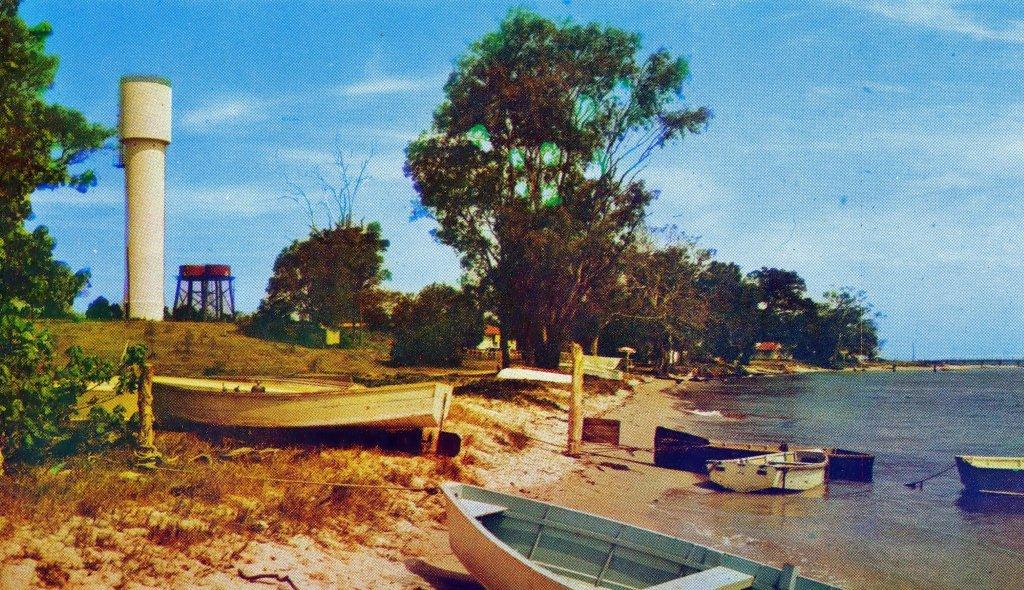
3. Bongaree water tower from beach, Bribie Island.

4. Cyprus Pine Avenue, Ocean Beach Road, Bribie Island.

5. Pelicans, Pumicestone Passage, Bribie Island.

6. Looking south to Wreck Point from Jetty, Bribie Island.

7. Ocean Beach, Bribie Island.

8. Safe anchorage, Pumicestone Passage, Bribie Island.

9. Shopping Centre, Bribie Island.

10. New Bridge and Toorbul Point from Bribie Island.

11. Bellara, from water ski lodge, Bribie Island.

ACKNOWLEDGEMENTS:
Thank you to Graham Mills.

Tuesday, 20 February 2018

Bongaree's jetties

Bongaree's jetties - more from Bribie Island
by Phil Rickard

Cover of Light Railways
LR259 February 2018.
Light Railway Research Societyof Australia Inc.


The following article is from Light Railways 259 February 2018, pages 14-17.
Reprinted with permission.


   I was most interested in Rod Milne’s article on the Tramways of the Moreton Bay Islands (LR 251, Oct 2016) and, like Rod, I was rather amazed at the spindly jetty on Bribie Island, seen in the photo on page 19 of that magazine. However, I suspect its raison d’être has been mis-understood. There were actually two jetties at Bongaree – the one depicted, plus the ‘normal’ passenger jetty just a few yards away to the right, and out of the picture. The photo in LR251 was taken from the foredeck of the ss Koopa which was berthed at the passenger jetty.


Bongaree jetty, viewed from the ss Doomba. Note the three jetty approach walkways,
dating the photo to post-1926. The centre (original) jetty was built in 1912 and
fitted with a narrow-gauge tramway in 1913. The clothing seems indicative of the
mid-1930s however, note, under the awning, the hatless lady in smart white shorts,
bare legs, short-sleeve top and high-heels, rebelling against the fashion status quo

Photo source: State Library of Queensland image 6798-0001-0001
   The story of Bongaree’s jetties starts in February 1902, when James Campbell & Sons Limited were granted a Special Lease (SL 724) over 12 acres of land on the western side of Bribie Island, on Pumice Stone Channel as a wharf site.[1] The following year, in August, the Brisbane Tug Company Limited was formed; a partnership between three existing firms that undertook towage in the port of Brisbane – Gibbs, Bright and Company; Webster and Company; and James Campbell and Sons. George Peter Campbell was named as manager and secretary. In addition to undertaking Brisbane’s towage, the new company declared that developing excursion traffic would be a priority.[2]

   The new company’s three tugs were not purpose-built tug boats such as we know today, but vessels also capable of being used as excursion steamers. The ss Beaver (222 tons) was certified by the Marine Board to carry 400 persons on Moreton Bay or 700 in the Brisbane River, the ps Boko (203 tons) could carry 253 persons on the Bay and 506 in the river and the ss Greyhound  255 on the Bay and 450 in the river. As there was generally only enough work for two tugs at Brisbane it was clearly good business sense to use any spare vessels on excursion traffic.[3]

   The ss Greyhound was the preferred excursion steamer and little time was lost in diversifying its use. One unusual trip was for the Eight-hours’ Day holiday at the end of April 1904. At this time Bribie Island was bereft of a jetty or landing and very few people lived there. The Greyhound ran a ‘camping excursion’ to Bribie on Saturday 30 April and returned to pick up the campers and picnickers on the Monday. [4]  Transfer to the beach was done by boats. In July the Beaver became the first of the company’s vessels to receive its new colour scheme, “a green colour [Aberdeen green] . . . with a red band around the funnel”.

Enlargement of the land end of the temporary staging, showing a small heap
 of gravel, with skips above. Height to rail level is about 13ft; the sea end being 
some five feet higher. For full picture, see Light Railways No.251.  
Photo source: State Library of Queensland image APA-114-0002-0007
   In October 1904, the company announced that the Greyhound or Beaver would institute weekly excursions to “Redcliffe, Bribie Island, South Passage, Pile Light and other favourite resorts”; not that Pile Light, about eight km north-east of the Brisbane River entrance, in Moreton Bay, could be considered a favourite resort! All vessels had their passenger facilities upgraded around this time whilst the Boko had its funnel reduced in height and mast cut so it could get under the Victoria Street bridge in Brisbane, for up-river excursions. Electric lights were installed throughout and Moonlight trips proved popular in addition to the normal Day return trips. The ‘Tug Company’ had clearly tapped a latent market; holiday traffic, especially, was proving extremely popular.

   Towards the end of 1905 the company obtained a 21-year lease on an acre of land at South Passage, on the southern tip of Moreton Island, and proceeded to erect a jetty (261ft long, no tram) for the landing of passengers. Again, this proved very popular as the spot allowed access to a much sought-after ocean surf beach on one side or, on the eastern side of the point, a shallow tidal pool suitable for children. Other events that proved popular included special trips with cheap tickets for children and parents, company picnics, fishing excursions, inspection trips whenever visiting naval warships (Commonwealth, British, Japanese etc) were in the Bay, visiting military encampments at Lytton and the free use of vessels for charitable events such as raising funds for hospitals.

   In February 1911, in a business restructure, the Brisbane Tug Company was acquired by a new company, the Brisbane Tug and Steamship Company Limited. The company’s issued capital was increased. George Campbell was appointed manager and secretary of the new company.[5] A key intention of the new company was to buy a fast, purpose-built pleasure steamer of large proportions, specifically for the Moreton Bay trade – in fact they had already been in consultations with a Scottish shipbuilder (Ramage and Ferguson, who had also built the Beaver in 1886) for many months. At the time, Brisbane’s population was about 150,000 and both railway and water excursions were big events, eagerly anticipated by all in the early years of the new century and a newly federated country. As much of the shoreline nearest Brisbane was tidal mud flats or mangroves, there was a growing demand for sandy ocean beaches and they could only be reached by steamer. This made trips to the various seaside resorts much sought-after by excursionists.

   Later in the year came the news that the new vessel, the ss Koopa (“Flying Fish”), had departed Leith, Scotland, on 17 October, and would arrive in Brisbane by the end of December. Such proved to be true, the Koopa arriving on Christmas Eve. The twin-screw steamer Koopa (416 tons) was built by Ramage and Ferguson Ltd, had a length of 192ft 6in, breadth of 28ft and draught of 6ft 6in.  She had two sets of triple expansion engines; cylinders 13, 21 and 34in diameter x 18in stroke, with steam supplied from two Scotch marine boilers. Top speed was 16 knots. Two decks for passenger accommodation were provided, the top, promenade, deck extending almost the whole length of the vessel. The lower, enclosed, deck had two main saloons. A kitchen, bar and confectionery kiosk were also included. The two funnels and the full-length covered promenade deck gave her a distinctive appearance.[6]

   After arrival, she was immediately put into service, running two well-patronised return trips to Redcliffe, a favourite beach resort, on Christmas Day and Boxing Day. On New Year’s Day, 1912, even larger crowds were carried; on three legs of the two return trips to Redcliffe over 1200 people were on board for each journey. One month later, the Queensland government granted Special Lease No.1628 over 12 acres on Bribie Island to the company. Effectively, this was another continuation of the 1902 five-year lease which had been extended in 1907 for another five years, to 1912. A key difference this time was that SL 1628 was for 21 years (at £2 per annum) and required a “good and substantial wharf” to be built.[7] The purchase of the Koopa and the expansion to Bribie Island were clearly two key parts of the Brisbane Tug and Steamship Company’s future plans.
Arriving at the Bongaree jetty; taken from the promenade deck of the ss Doomba, March  or April 1924. The temporary staging, to facilitate the import of stone and gravel for construction of the company’s private road, is clearly seen – with one skip visible – beyond
the passenger jetty. The ss Porpoise is largely hidden behind the jetty shelter shed. Three men  and the top of the skip being filled, can just be seen above the roofline. Compare with next photo.  The row of huts in the background were built by the Brisbane Tug Company and often referred to as the ‘Twelve Apostles’.  
Photo source: State Library Queensland image APA-114-0002-0003

The ss Porpoise at the temporary construction staging, at Bongaree in 1924, taken from the foredeck of the ss Doomba. The Porpoise is known to have been at that jetty in late March and early April when George Hallett got his fingers jammed in some machinery[1]. The Porpoise (125 tons) was built in Sydney in 1875. She was 103ft 8in long, 17ft 9in wide and 6ft 9in draught and had a 2-cylinder compound engine rated at 12hp. Purchased by John Burke Limited in 1908 for use as a coastal trader. Note the scoop fitted to the derrick, being used to transfer stone or gravel from her hold to the skip on the elevated staging.  A similar photo, but with the lighter Pirra (owned by T F Moxon), may be seen in the SLQ’s image APA-114-0002-0008.  


[1] Daily Mail, Bris. 29 Mar 1924; Telegraph, Bris. 4 Apl 1924
Photo source: State Library of Queensland image APA_114_0002_0004
   In mid-January the ss Koopa made the first of many trips to Bribie Island (it would serve the island until May 1953), though it could not land passengers as the company’s jetty had yet to be completed. By early May that deficiency had been rectified; Sunday the 12th is thought to be the first time the Koopa berthed at the new jetty at Bongaree. Bribie Island had arrived as a tourist destination, even if it was somewhat rural and rustic! It was good for picnics and camping, had a beach on the bay side of the island whilst an hour’s walk enabled one to reach the ocean surf beach. In early June the Koopa carried company shareholders and friends on a special trip to Bribie Island to view what had been accomplished. Luncheon was partaken on board whilst berthed at the new jetty and a band provided entertainment.[8] The jetty, constructed by Taylor Bros., well-known bridge, wharf and pier contractors of Bulimba, was 200 feet in length by 10ft wide, leading to a T-head 75ft x 16ft.[9] Previous to the Koopa entering the Tug Company’s fleet, excursions were usually suspended for the winter months but, with a purpose-built vessel now available, trips were run every weekend, even in the off-season and Bribie was usually the destination.

   In November 1912 the government declared the new ‘Town of Bongaree’ adjacent to the company’s jetty, conducted a survey and placed 100 blocks, each of one rood,[10] up for auction. These were eagerly sought after and most lots were sold at between £5 and £31 each, well above the upset price. Another sale followed in December 1913; prices ranged from £20 to £42. The price increases clearly showing where Bribie was heading. Further sales followed in subsequent years.

   Over the years the company made various other improvements at Bongaree – in 1913 they laid a narrow gauge tramway along the jetty and supplied a trolley for conveyance of luggage and stores, erected jetty railings, and a stylish shelter shed at the jetty head.[11]  Changing sheds and lavatories were erected at the beach for use of excursionists. Private enterprise provided a store and boarding houses and the company built a row of twelve huts along the foreshore, north of its jetty. These were quickly dubbed the ‘Twelve Apostles’ and appear in many early photos of Bongaree.

   In  early January 1914, the Queensland government granted the Tug Company’s secretary, George Peter Campbell, Special Lease No. 1862, for 21 years over a narrow strip of land across Bribie Island for the purpose of building a tramway.[12] The area, stretching from the jetty to the ocean beach, together with blocks at each end for termini, equalled about 58¼ acres. The rent was £2 per annum, for the first six years and subject to review thereafter.[13] It seems Campbell was embarking on a private venture. Unfortunately, the Great War intervened.

   In 1920, at the rent review hearing, Campbell advised that the original lease was obtained [signed?] on 31 March 1914. It was then found that the Minister for Railways had to give permission, a rather slow process. Then a London agent was needed to purchase the plant with Burns, Philp and Company eventually being appointed. They were arranging for the plant and material to be purchased from Belgium when war was declared, and advised Campbell to await the end of hostilities. The war was now over but the price of material was said to now be five [sic] times what it was in 1914. Campbell stated that he had had a survey made at a cost of £100 whilst also keeping a walking track open along the easement. He hoped plant would soon be available at a reasonable price so work may proceed. He was granted the same rent as that existing, £2 per annum for another six years.[14]

   Still events moved slowly. In early December 1922 tenders were called for the clearing and grubbing of the two-chain-wide easement.[15] By March 1923 this was subject to some industrial troubles over hours worked and the matter ended up in the Arbitration Court in Brisbane. The dispute was between the Australian Workers’ Union (AWU) and the Brisbane Tug and Steamship Company (confirming that, ultimately, the company was behind the tramway scheme), jointly with Queensland Employers’ Federation. Around ten men were engaged in the clearing work under foreman William Shirley. Though clearing work was completed by mid-May, the Tug Company had a reality check and decided to construct a roadway, rather than proceed with the tramway.[16] Railway material was proving expensive whilst road vehicles seemed to offer a less costly and more flexible alternative, considering the small distance to be traversed. Road work was well underway by September 1923, a visitor reporting a ‘lively scene’ with bullock team, grader and scoop at work.[17]  
Bongaree 1924. Temporary elevated staging. Passenger jetty on right with luggage
trolley just visible. Two skips are at the far end of the staging with Blake Bros’
International truck nearby. The Tug Company’s road stretches into the distance.
 What a great view the kids had from the swings outside the caretaker’s cottage!   
Photo source: VC8_118 Vera Campbell
photos / Ted Clayton collection, BIHS Historical database.

   As stone for the road (or railway had it gone ahead) was unavailable on sandy Bribie, it had to be imported. To this end, Blake Brothers, carriers from suburban Windsor, were engaged to provide gravel and stone. This came from Bowser & Lever’s quarry at Windsor and was trucked by Blakes to a wharf in Brisbane whence it was shipped to Bongaree by various ships and lighters. An elevated staging was erected using the rather slim paperbark piles visible in the photos. This staging was about 120 yards in length and had double track at the jetty head. Road metal and gravel was unloaded by the various vessels’ steam-powered derrick and a grab, into standard 2ft-gauge side-tipping skips. Photos show at least two, that being the reason for the double track at the head; whilst one truck was being loaded, the other could be wheeled ashore. There, the material could either be tipped to a heap or emptied directly into Blakes’ motor trucks for movement to the required site. If dumped, it was later reloaded via another couple of skips operating up a short ramp and emptied into motor trucks – the below photo shows the arrangement.
Adjacent to the gravel heaps at the base of the elevated staging (and hidden
in the other photos) was this reload ramp. A couple of skips would be filled
with gravel and hauled up a short ramp using a block and tackle, with a horse
(out of sight to the left) providing the motive power. One of Blake Bros’ motor
trucks will then be backed under the structure and filled. 
Photo source: WO9_888012 Blake Bros.
photos / Warwick Outram collection, BIHS Historical database.

   The ‘first-class macadamised motor road’ was virtually finished by the end of September 1924. Indeed, from late August (and even earlier – i.e. Easter, along much of the way) the Tug Company had been running a motor omnibus along their road at ‘one shilling per return journey’.[18] A month later the company hosted an invited party including the Acting Premier, William Gillies; various ministers and MLAs. After luncheon on the ss Koopa, the party drove over the new road to the ocean beach at Woorim.[19] With the road’s completion the temporary elevated staging was dismantled. It was said that the Tug Company had spent around £8000 on the entire venture. One journalist claimed it was the best road around Brisbane![20] Within a few months the company had three buses available along their private toll road. In December the Queensland government declared a new town – Woorim – at the ocean beach-end of ‘Campbell road’, and started selling lots.

   The Tug Company continued to improve and build additions on the island. In September 1922, at their instigation, the telephone was connected. Later in the same year they donated land for tennis courts to be constructed. On 24 November 1923, the company’s newest vessel, the ss Doomba – even larger than the Koopa, came to Bribie for the first time. In 1926, with the Bongaree jetty barely able to cope with the crush of passengers, two additional jetty approaches were constructed out to the T-head which was, itself, widened to 40 feet. Only the centre jetty (the old one) carried a tramway. Shelter sheds were added at the ocean beach, plus a life-saving reel. A bowling green was constructed at Bongaree; a water tank was provided with clean drinking water and, in 1929, a kiosk for the sale of oysters and seafood built near the jetty. By 1933 the company had carried more than one million excursionists to Bongaree.[21] Bribie Island was now one of the premier beach resorts around Moreton Bay, principally due to the foresight and drive of the Brisbane Tug Company and, specifically, G P Campbell.

Acknowledgements and references
My grateful thanks to Donna Holmes at the Bribie Island Historical Society for answering my numerous questions and freely giving of her knowledge of G P Campbell’s activities pertaining to Bribie, and providing access to the society’s photographs. The society’s interesting blog may be found at http://bribieislandhistory.blogspot.com.au/ and is well worth a visit.


[1] Queensland State Archives ID 24553
[2] The Telegraph, Brisbane 4 Sep 1903
[3] The Brisbane Courier, 3 Oct 1903
[4] The Brisbane Courier, 26 Apr 1904
[5] The Telegraph, Brisbane 4 Feb 1911
[6] The Brisbane Courier, 17 Oct 1911
[7] The Queenslander, 23 Dec 1911
[8] The Brisbane Courier, 5 Jun 1912
[9] The Brisbane Courier, 23 Apr 1912
[10] One Rood = ¼ acre [1012sq m]
[11] The Brisbane Courier, 31 Jul 1913
[12] Queensland State Archives ID 333167
[13] The Brisbane Courier, 10 Jan 1914
[14] The Daily Mail, Brisbane 18 Aug 1920
[15] The Brisbane Courier, 8 Dec 1922
[16] The Daily Mail, Brisbane 25 Jun 1924
[17] The Daily Mail, Brisbane 2 Oct 1923
[18] The Daily Mail, Brisbane 21 Aug 1924
[19] The Brisbane Courier, 1 Nov 1924
[20] The Brisbane Courier, 12 Sep 1924
[21] The Telegraph, Brisbane 4 Jul 1933

Wednesday, 16 August 2017

Bongaree Jetty Heritage

Bongaree Jetty and Bongaree Esplanade
Heritage site signs
Bongaree Jetty and park area, Aug 2017.
Photo: Donna Holmes

A walk along the Bongaree Jetty and Esplanade precinct is very pleasant and allows an opportunity to read the information contained on several Heritage site signs.

In this picturesque area there are three Heritage site signs which were unveiled in 2004.

For those folk who are not able to walk through this lovely area, below is a copy of the signs and information about their unveiling.

The Bribie Jetty, Jetty Precinct and Twelve Apostles Lookout Heritage site signs were unveiled on Sunday 5 December 2004 at the Official Opening of the newly refurbished Bongaree Jetty and Bongaree Esplanade Improvement Project.

Source: BIHS database GEN_011

Program for the Official opening of the newly refurbished Bongaree Jetty and Bongaree Esplanade Improvement Project.


                       The Heritage Site signs give a brief history of:

Bribie Jetty           Twelve Apostles Lookout        Jetty Precinct

     Bribie Jetty [Heritage Site sign]
Source: BIHS RP2_001_jetty2004

1911 The Birth of Modern Tourism in Queensland


Caption: The Brisbane Tug and Steamship Company established the first Island tourist resort in Queensland on the 153 sq km Bribie Island. Prior to this, the Tug "Greyhound" and then "Beaver" had opened up a service to Bribie in 1901.
SS Koopa photo by permission of the Hall Family.


1912 The First Jetty at Bongaree
Caption: The Brisbane Tug and Steamship Company built the first jetty at Bongaree and commissioned the SS Koopa to transport tourists from Brisbane and Redcliffe. Since then the jetty has been expanded, reduced and rebuilt many times.
Photo by permission of the Campbell Family.

1920s The Golden Years


Caption: Prior to the great depression, up to seven ships were tied up at the jetty. Thousands of tourists disembarked on first one walkway then two and then three, with an extended head connecting the multiple walkways. It is interesting to note that in 1917 a competitive destination "Umbigumbi" opened, this is now known as Surfers Paradise.
Photo by permission of the Campbell Family.


1911-1961 ss Koopa Luxury Steamship
Source: BIHS RP2_009_Heritage
Caption: This 62-metre vessel could carry up to 1200 passengers and at one time even had an orchestra for entertainment. The travel time from Brisbane to Bribie was a leisurely three hours. To cope with shallow waters in Pumicestone Passage it had a flat bottom hull to achieve a draft of two metres. As per the 'Packet License' regulations at the time, at three nautical miles from the home berth, the stewards opened the lavish bar on the lower forward deck. On the intermediate deck, patrons could enter the casino, where they mostly played poker. Excellent food was also served. For example: Oysters with buttered bread were 1/- (one Shilling) per plate. At night the ss Koopa was an impressive sight as she was well lit with a total of 159 lamps. During WWII the Royal Australian Navy commissioned the ss Koopa in 1942. After her war service she was returned to public service. The locally formed Moreton Bay Development Company bought the Koopa and began operation in early 1952. Their objective was to keep the Koopa operating until the bridge was built bu ceased operating in 1953. The Koopa continued on various runs until finally scrapped around 1961. The bridge opened in 1963 ending this era of steamship transport.
Photo by permission of John Oxley Library.


1923-1939 ss Doomba 
Caption: This 70-metre vessel could carry up to 1524 passengers. Formerly H.M.S. Wexford, the vessel was built in 1919 and arrived in Brisbane in November 1923. She was refitted as a passenger ship with a promenade deck added to seat up to 280 passengers. The Wexford was then renamed the ss Doomba. Her fastest run to Bribie was two hours (excluding berthing in Redcliffe) and she touched a top speed of 19 knots. The Royal Australian navy re-commissioned the H.M.A.S. Doomba in 1939 and she served once again as a minesweeper, mainly in Bass Strait. After the war she was sold and used as a bulk carrier and finally as a barge. She was eventually scuttled in 1976.  Photo by permission of the Hall Family.
1920 Campbell's Kiosk


Caption: 
The Campbell's Oyster Kiosk was very much a family affair. They were a great fishing family with the father Joe Campbell registered as an oysterman having taken charge of local oyster farming operations around 1905.  The Campbell's also hired out boats at 5/- (Shillings) a week and went on to open a cash store on the Esplanade in 1953.
Photo by permission of the Hall Family.


1921 Camping Grounds on the Foreshore at Bongaree


Caption: Looking towards what is now Brennans Park the scene would have looked very different in the 1920s. In the top left hand corner of the photograph is the Brisbane Tug and Steamship caretaker's residence. Underneath this building was the location of the first post office on Bribie Island.
Photo by permission of the John Oxley Library.


1923 Bongaree Streetscape

Caption: View of the township of Bongaree in 1923. The large building on the left hand side of the photograph was the Hall and Bestmann general store. In the centre of the photograph are stacks of tent poles for hire.  The elevated building on the right hand side of the photograph was the caretaker's residence.
Photo by permission of the John Oxley Library.


1924 Road from Bongaree


The road from Bongaree to Woorim was completed and four Model T Ford passenger buses take holiday makers to the Brisbane Tug & Steamship Company Hotel at Ocean Beach.


1951 Bribie Island Bus
Caption: The photo shows a more modern Bribie Island bus meeting the passengers from steamships. The buses operated between the Jetty and Ocean Beach Woorim.
Photo by permission of the John Oxley Library.


1963 The Bribie Island Bridge
 The 831 metre Bribie Island bridge officially opens at a cost of £358,156 and the era of water transport is effectively over. To recover construction costs a 5/- Shilling toll was placed on the bridge until 1973.
Special Thanks to local historians Warwick Outram and Ron Powell for their invaluable assistance with historical research.

1999 Celebration of the Bicentennary of Matthew Flinders' Landing on Bribie Island 16 July 1799

Acknowledgement: This plaque also acknowledges a commemorative ceremony held on 16 July 1999 to celebrate the Bicentenary of Matthew Flinders' Landing on Bribie Island 16 July 1799.

The 1999 ceremony focused on the planting of a Flindersia australis species (crows ash) tree by His Excellency Major General Peter Arnison AO Governor of Queensland, Honourable Peter Beattie MLA Premier of Queensland and Cr Tom McLoughlin Mayor of Caboolture Shire.


 Twelve Apostles Lookout [Heritage Site sign]
Source: BIHS RP2_001_jetty2004

1925 Dance Hall, School and Bowls Club
Source: BIHS RP2_009_Heritage


Caption: Near to this site was the Bribie Island Dance Hall. This was also where the first School on Bribie Island was conducted. Later the stumps were removed and the hall was re-located to become the first clubhouse for the Bribie Island Bowls Club.
Photo by permission of the Hall Family.


1920s Twelve Apostles
Source: BIHS RP2_009_Heritage


Caption: Around 1918 just after the war the Brisbane Tug and Steamship Company constructed twelve huts on their foreshore leasehold just behind the Bribie Jetty.

In the foreground of the photograph is a temporary jetty for unloading road metal (gravel) during construction of the first road to Woorim.

The aim was to provide cheap holiday accommodation for visitors who did not wish to camp. 

In later years these twelve apostles, as they became popularly known, were to provide more permanent accommodation to the Island's pensioners.
Photo by permission of the Hall Family.


1901-1912 Tugs on the Leaning Fig
Source: BIHS RP2_009_Heritage
Caption:
From 1901-1912 the tugs 'Beaver' and 'Greyhound', which had been refitted to carry passengers, transported early visitors to the Island.

Prior to the Jetty (shown in the photo just completed in 1912) passengers were transferred to the shore in a square end Punt with seats all around. The Punt was hauled ashore and secured to a tree. That tree is believed to be the leaning Fig adjacent to this site.

Photo by permission of John Oxley Library.


Welcome to the Jetty Precinct [Heritage Site sign]
Source: BIHS RP2_001_jetty2004

1932 Hall and Bestmann General Store
Source: BIHS RP2_009_Heritage
Caption: In 1913 Alfred Hall and Artie Bestmann started what was to become the first general store at Bongaree. Alfred Hall owned a grocery store in Brisbane and started by bringing up some groceries and selling them through the kitchen window. In 1921 they built the purpose built store shown in the photograph next door to their residence.
Photo by permission of the Hall Family.


1924/25 Toll Road and Early Transport
Source: BIHS RP2_009_Heritage
Caption: To recover the construction costs, the road from Bongaree to Woorim had a Toll of 1/- (One Shilling). During its construction road material was brought from Brisbane and crushed at Bongaree. A horse attached to a skip by rope pulled it up a ramp. A truck drove under a level section of the elevated ramp and workers tipped the skips to drop the road base into the truck. The 1925 photo here shows a self-made roundabout for tour buses. 
Source: BIHS RP2_009_Heritage
 Model T Ford passenger buses take holidaymakers to the Brisbane Tug and Steamship Company Hotel at Ocean Beach Woorim. Bus fares ranged from 9d (nine pennies) for children to 1/6 (One Shilling and sixpence) for adults.
1920 Holiday Time at Bribie in the Early Days


Caption: This is the scene you would have seen in the 1920s. Tents and the ss Koopa tied up at the Jetty. 

Photo by permission of John Oxley Library.


1920s Shops and Guest House - Northern Side of the Jetty
Source: BIHS RP2_009_Heritage


Caption: The facilities available in the 1920s included a Cafe, Museum and Boarding House. The Cafe's veranda reached out onto the water's edge.
Photo by permission of Mr. Sam Hawkins.


The Jetty Precinct looking towards First Avenue
Source: BIHS RP2_009_Heritage


Caption: 
This photograph shows a view of the Jetty, Camping Area and First Avenue going straight ahead to Woorim. To the left of the Jetty is the temporary gantry for unloading the road metal.
Photo by permission of the Campbell Family.


Acknowledgements:
The above photos have been collected by the Bribie Island Historical Society for the BIHS Historical Database, particularly from the collections of Peta Newcomb, Robert Price and Donna Holmes.