Showing posts with label Pumicestone Passage. Show all posts

Friday, 25 April 2025

1886 trip to Caloundra

 The following Letter to the Editor describes a trip from Brisbane through Pumicestone Passage to Caloundra, during Easter 1886, by thirty "friends and acquaintances" aboard the steamer Mavis.

1886 Easter Trip through Bribie Passage
on the Mavis

Our Easter Trip.

To the Editor. – Sir, - Do you know where and what Caloundra is? I had a vague idea as to its whereabouts from seeing the place on the map, but I must confess that, having largely discounted the various reports I had previously heard of the place, I had no idea as to what it was like till this last Easter, when an opportunity presented itself and was promptly seized for visiting the place.  

The steamer Mavis was secured by Mr. Isaac Markwell, and in possession of a neatly got-up ticket and the necessary blanket, toothbrush, &c., I joined the boat at Messrs. Campbell’s wharf a few minutes before 6 p.m. on Thursday, the 22nd instant, and found myself one of a party of about 30, mostly friends and acquaintances, all bound on the same errand.  

Starting soon after, the run down the river commenced, and in due course we crossed the bay and took the passage between Bribie and the mainland.  This passage should be gone through to be able to realise what it is.  We did not get through that night, as in the small hours of the morning, when negotiating a particularly intricate spot called familiarly “the double u’s”, in the darkness our genial skipper took the wrong side of a beacon, and, with a falling tide, it was soon evident that we were securely beached for at least 24 hours.  About 5 a.m. a boat party left for Caloundra on relief bent, and returned shortly before dinner-time with the intelligence that two boats were on the way to our rescue.  One of the boats which arrived soon after was a splendid cutter, owned and sailed by the old identity and fisherman, Sam Leach.  He did good service, as he took away a considerable portion of our skipper’s cargo, as well as about a dozen of our passengers with their dunnage.  Other two boats took a smaller share of both.

Life on the Mavis on Good Friday was enjoyable, although she was hard aground.  Much bathing and fishing were indulged in, and were provocative of amusement, especially to the onlookers.  One gentleman, in particular, after bathing, started down the channel minus his small clothes, on fishing bent, and his sudden and unexpected flounderings, when he struck a soft patch, were hugely enjoyed by the onlookers; and his frantic efforts to extricate himself were no doubt greatly assisted by the enthusiastic cheers from the boat. 

Excursion to Caloundra
Map from 1983 excursion by R.G.S.A. to 
commemorate the first trip of the Mavis.
Source: James Schroeder Campbell collection

We got off the ground early next morning, and arrived at the Caloundra jetty about 6 a.m.  Breakfast over, nearly all who remained by the boat paid a visit to the observatory on Mr. Bulcock’s selection, whence a splendid view of the Pacific was obtained; to the telegraph office, to send messages of safe arrival to friends in Brisbane; and then on to the heads, for the views, to bathe in the rollers, and to partake of an al fresco luncheon on Mr. Moffatt’s veranda.  The land owned by Mr. Moffatt, originally a mineral selection of 320 acres, constitutes in the minds of most persons the pick of Caloundra, and its fortunate owner is to be congratulated on the foresight displayed by him in securing such a beautiful sight.  The Caloundra Heads are comprised in it, and the views from the different elevated portions are unsurpassed in coast scenery in Queensland.  

The cliffs on the seaside are a study for the geologist and the lover of nature, as also are the rocks at the foot, in places as level as a pavement and strewed with boulders and logs of petrified wood.  Not affecting a knowledge of geology, I am not able to give any description of the formation, or the nature of the rocks, but I could and did enjoy to the full the wonderful appearances presented by them in the face of the cliff and on the beach.  

Plenty of beché de mer, sea anemones, shells, &c., were easily obtainable, but the fish were shy, owing doubtless to the high wind which prevailed, not only on the Saturday, but also on Easter Day, and many were greatly disappointed thereat, enough and in variety of fish were, however, caught to show the capabilities of the place, and the spectacle of a large rock cod, computed to weigh at least 2 cwt. lying on the beach near Mr. North’s selection (where caught) in close proximity to a decent sized shark (also caught at the same time and place), proved conclusively to the incredulous (and I confess I was one) that the recent descriptions of the large cod caught were not a fable, and if at all, were only slightly exaggerated.  

Monday, at 2.30 a.m., saw us on our way to Brisbane, which, after an uneventful and rather tedious passage, was safely reached at 2.15 p.m., in time for those, who had a fancy that way, to go and see our gallant army storm and defend Brisbane.  I think I may safely add that all were well pleased with the trip, and especially with having made the acquaintance of Caloundra and its inhabitants, who all seemed pleased with us and made us welcome.

Yours, &c., ONE OF THE PARTY.

REFERENCES

Letter to the Editor entitled Our Easter trip by 'One of the Party"
The Telegraph (Brisbane) Sat 1 May 1886 p. 2 http://nla.gov.au/nla.news-article174706179

Map from Information Leaflet for the Excursion to Campbellville - 26 January 1983. Royal Geographical Society of Australasia. 5 pages. The excursion commemorated the centenary of the first trip of the paddle-wheel steamer Mavis on 26 January 1883. Held in: James Schroeder Campbell (1913-1989) collection, BIHS.

FURTHER READING

Backward Glance - Coastal and River vessels of Yesteryear
https://www.sunshinecoast.qld.gov.au/news/backward-glance-coastal-and-river-vessels-of-yesteryear-161219

The steamer Mavis was launched in 1883. The Week (Brisbane) Sat 6 Jan 1883 p. 8 http://nla.gov.au/nla.news-article183696488

Monday, 26 June 2023

The Glasshouses

Renowned Australian authors Vance Palmer (1885-1959) and Nettie Palmer (1885-1964) lived economically "by their pens" at Caloundra from 1925-1929. The following article entitled The Glasshouses was written by Vance Palmer in 1927 - almost one hundred years ago.  These distinctive geological landforms still have a wonderous presence today and as Vance wrote below "have the same power of steeping the mind in mystery and casting a spell over the imagination".

The Glasshouses
by Vance Palmer
1927

On entering Moreton Bay by daylight one is struck by the fantastic shapes of a group of bare mountains that rise from the low, scrubby shores of the mainland. In the morning light, with the sun on them, they look as if they were made of crystal; at dusk they might be cut out of cardboard, so sharp and definite are their lines, and so flatly do they arrange themselves along the horizon. 

The wonderous view of the Glass Houses at sunset.
Photo: Queensland Government
Glass House Mountains National Park webpage

At any time their aspect is surprising. The highest of them, Beerwah, is the exact replica of one of the Pyramids, and the others, each in its own way, suggest monuments of ancient Egypt. What intrigues the imagination is that they rise, independent and separate, out of flat, almost marshy, country, and are not conected with any range of mountains. This gives one the queer feeling that they have some human significance; that they are the relics of an old civilisation, and not merely natural features of the landscape.

Captain Cook noted them on the skyline when he sailed along this coast nearly a century and a half ago [now nearly two and a half centuries ago], and named them the Glasshouses. From the low decks of his little ship, or even from the rigging, he could only have seen the tops of them, with Moreton Island lying between, but he seems to have been struck by their strangeness. Flinders, some years later, got a clearer view of them. While his ship was lying at the southern end of Bribie Island he set out with a few men in a boat with the object of climbing the highest of them. Making his way up the passage he landed, and penetrating the dense tea-tree scrub he reached the base of one of them, but after gazing at the rocky escarpments above him he returned unsuccessful. His opinion was that they were inaccessible. Since some of them are easily scaled, even by ordinary climbers, it must have been one of the three chief mountains — Beerwah, Coonowrin, or Tibrogargan — that thwarted Flinders. It is a pity, for from the top of any of these three he would have gained a sight of the main object of his search — a river flowing into Moreton Bay.

None of these extraordinary peaks is quite inaccessible, as later explorers have proved. The highest of them, Beerwah ("up in the clouds" it meant in the native tongue), was climbed by Andrew Petrie in the 'forties. There is a pathetic story told in connection with this feat. A good deal of the folklore of the neighbouring native people was naturally connected with these striking Glasshouses, and they firmly believed that an evil spirit presided over Beerwah — a spirit that would turn anyone blind who attempted to invade its fastness. Since Andrew Petrie was their friend and protector they did their best to dissuade him from the attempt, but the sturdy old Scot laughed at them and found a path to the summit. His son records that when he actually did go blind later on, an acute tragedy to him in his vigorous middle-age, the native people took the fatality for granted. He was only paying the penalty, as they had foretold! 

But other people have climbed Beerwah since then without evil results. Although the highest of the Glasshouses, it is not the steepest. At the base there is a dense, twisted scrub that thins out higher up into shrubs and grasstrees, and, except for a couple of hundred feet of sheer rock rising almost perpendicularly, a scattered fringe of vegetation runs to the very top. Nor would the height (1,760ft.) seem formidable to New Zealand climbers. Like the others, its uniqueness lies in its shape, and in the way it rises suddenly from a swampy plain that was once a sea bed. From the top one gets an uninterrupted view over the dazzling panorama of Moreton Bay, with its grey-green islands, its sandy foreshores, and its wide expanse of blue water. It is a pity that the intrepid Flinders did not persist in making the ascent.

Of the other two major mountains, Tibrogargan (shaped like a helmet) has been climbed fairly often, but Coonowrin is a different proposition. In form it is a pyramid, with a great pillar of rock, several hundred feet high, rising perpendicularly from the summit. The approach up the sides of the pyramid is fairly easy, but when one reaches that massive pillar, smooth as the sides of a bottle, there seems no possibility of making the ascent. Until near the end of last century it was given up as impossible. Then a young artillery man, named Harry Mikalsen, who had been brought up near its base, succeeded in reaching the summit. He had formed the ambition of doing so when a boy, and had studied it from all angles and in all lights, tracing footholds and fissures in the rock till at last he found a path. A path, did I say? Even the chamois deer would hardly regard it as that, for at one point the only possible means of progress was up a thin, tall sapling that happened to grow in a line parallel to the face of the cliff. A few other people have since made the ascent, with Mikalsen to guide them, but there is never likely to be a beaten track to the summit.

What is the origin of these strange mountains? Geologists say they are volcanic eruptions of incredible age, probably from an ancient seabed. Through succeeding aeons they have passed through many changes. Once, when they were extinct and their sides were covered with crumbling lava, a thick vegetation began to clothe them. The wind and weather of centuries eventually wore off the crumbling surface at their crests, and most of the vegetation with it, leaving the basic rock exposed. The smooth pillar, for instance, which makes the climbing of Coonowrin so difficult, is formed of the molten stone that once plugged the crater of the extinct volcano. In practically all the Glasshouses hints of these plugs of molten stone can be seen; but in Coonowrin the outside shell has been more deeply worn away, so that the plug is left naked to every eye. It is like looking at the bones of an ancient dinosaur. That indefinable atmosphere of an earlier world hangs about it, and almost oppresses the imagination. Even the vegetation that clings about its base now — spiky shrubs, grasstrees with pointed spears and blackened trunks, and writhing teatrees — seem to belong to a vanished age — an age when everything was hard and horny, before the softness of the fern-world.

But, seen in the distance, they are strikingly beautiful. From many places along the northern coast of Moreton Bay one gets glimpses of them, and they seem to arrange themselves along the skyline, like a set of quaint hieroglyphics. The farther one gets away from them the more fragile they appear, and the more do their domes and pillars take on the semblance of crystal. There is a magic about them that makes them impossible to forget. I do not know any mountains that have the same power of steeping the mind in mystery and casting a spell over the imagination.

References:

The Glasshouses by Vance Palmer
The Australasian 4.6.1927 p. 70 [viewable via National Library of Australia's Trove online resourchttp://nla.gov.au/nla.news-article140734966 ]

Glass House Mountains National Park, Sunshine Coast. PHOTO
https://parks.des.qld.gov.au/parks/glass-house-mountains/about/culture

Biography of Edward Vivian (Vance) Palmer (1885-1959)
by Geoffrey Serle, 1988, Australian Dictionary of Biography v. 11.
https://adb.anu.edu.au/biography/palmer-edward-vivian-vance-7946

Saturday, 4 June 2022

Toorbul on Elimbah Creek

 The following delightful letter was written in 1900 by 12 year old Essie for the "Children's Letter to Delphia" competition column in The Queenslander. Essie describes living at their house called "Elimbah" at the mouth of Elimbah Creek at Toorbul with her two older brothers and two older sisters.

Toorbul on Elimbah Creek (1900)

By Essie

Dear Delphia - Seeing in the Queenslander that you have a letter competition, I am going to try and win one of the three prizes. I cannot tell you much about this district, as we only came to live here about two months ago [Lawnton]. But I am going to tell you a little about the district, which I have just left [Toorbul].

It is a very quiet place called Toorbul and is situated on the banks of the Elimbah Creek, and about 12 miles out of Caboolture. What makes Toorbul so quiet, is the people live so far apart from one another, the nearest neighbours being a mile away ; some of them being three and four miles away from each other. I do not know how Elimbah Creek got its name, but I think it was from the black people as I hear that Toorbul and Bribie Island had lots of them some years ago. Our house was called "Elimbah" because it is situated just on the mouth of the Elimbah Creek. Bribie Is. is just opposite our house, so we had a lovely view of it down the passage ; as the creek runs in such a strait sheet across to Bribie. It is called the "Passage."

It was lovely to sit on the verandah and watch the waves rolling over one another. Mr. Bishop used to pass by our house in his cutter twice a week, we used to get frightened to see how his boat would lay over on her side, on a rough day. We were expecting every minute to see the water go over the side. Mr. Bishop brings oysters to Brisbane every week in his cutter from the oysters beds about here. I will tell you where the oyster beds are situated : Donney Brook, Ningi Creek, and Toorbul Point. There is also a Fish Company at Toorbul Point where they tin Schnapper, Bream, Jew Fish and Whiting, some of the latter they catch in the Elimbah Creek. The Sword-fish is very plentiful in the creek, and if you can catch them, and get their Sword, it makes a very pretty ornament. My sister has one a little over a foot long which she thinks a great deal of. On Bribie Island there is a nice lot of pretty shells, my brother went out for a sail and he brought me a few.

I was only once on Bribie Island : but my father and brothers used often to sail over in our boat. I could row it across the creek but my sister wouldn't let me go by myself very often. I have two brothers and two sisters, all older than myself. I am twelve years old and in third class. I go to the North Pine State School now.

At Toorbul there is only a Provisional School and only one teacher. Just a while before we left Toorbul, we got a new teacher our old one "Mr. Ross" went to the war with the Third Contingent. We were all sorry when he left our school. We had about 4 miles to go to school, and we had to cross the creek every morning and night in a boat. Toorbul is a great place for wild flowers, all varieties being numerous. The trees that grew there being :- Gum, Tea Tree, and Cyprus Pine, and Waterfowl of all kinds are also very numerous in Summer, but they nearly all disappear in Winter.

The Magpie and Butcher bird are very common up there. Dear Delphia, I must tell you a little about a butcher bird my brother caught. He got it when it was quite young, and we fed it on bread and worms, and he became quite tame, and learned to talk. He was very fond of milk, and would stretch his neck to look into the cups for some. I had a little wide necked bottle which I used to fill with milk for him, and he used to go to it whenever he wanted a drink. But I am sorry to tell you that one of the horses tramped on him and killed him. He used to get into the horse's box and somehow or other we found him dead, and we think the horse must have killed him.

My father keeps a lot of cows but only a few are milking, my brother and sister milks them. I am learning to milk. I milk one cow. We made butter when we were living at Toorbul, but we sell our milk down here and I can tell you I miss my drink of butter milk.

Essie,
Lawnton, June 18th 1900

Dear Delphia, this is the first time I have written to you, next I hope to tell you about this district. I forgot to tell you that we are having a concert and Arbor day Picnic on the 29th of this month. I think I have made my letter long enough so will conclude with love from ESSIE

REFERENCE

Children's Letter to Delphia, written by Essie of 'Elimbah', Elimbah Creek, Toorbul.
The Queenslander, 30.6.1900 p. 1215 http://nla.gov.au/nla.news-article18551204

Tuesday, 22 March 2022

Donnybrook Pumicestone Passage

 The village of Donnybrook on Pumicestone Passage is noted as a fishing spot. The following article from 1939 paints a picture of what is was like over 80 years ago.

Do you know where Donnybrook is? (1939)

written and illustrated by Roy Parkinson

If you take up a map of Moreton Bay, turn to the northern end, and follow up the Bribie Passages towards Caloundra to Goat Island - easier with the pencil point than with a boat, since the shoals come thick and fast - you will notice that here the channel divides, and on the left-hand stream a little spot is labelled Donnybrook, or according to some charts, Bribie View.

The best way of getting to this place from Brisbane is to go by car to Beerburrum, there to turn off for the nine miles of bush track which leads direct to it. There is another road from Caboolture, but as residents of Donnybrook speak of it as "the bog," the conclusion is obvious.

The track from Beerburrum is quite good, and a pleasant surprise awaits the traveller at the end of it, for a quaintly attractive little place is found, typifying the fishing villages as described so graphically by Vance Palmer in "The Passage."

Donnybrook consists of about five tiny cottages and a kiosk, and the be-all and end-all of life is Fishing. The capital "F" is very necessary. At one end the Dux fleet of boats operates, and a quarter of a mile away the Benson navy rules the waves. Willie Benson, a bright lad of 14 who knows the channels as he knows the palm of his hand, and steers a boat with his eyes shut, has only once been up to Brisbane and wouldn't feel in the least put out if he never came again! At week-ends, when visiting anglers arrive, upwards of 50 boats may be scattered over the channel. After a day's fishing the correct thing to do is to repair to the kiosk for scones and strawberry jam!
Donnybrook - "A cleared and grassy area crowns
a high point of land overlooking the water..."
illustration and description by Roy Parkinson
source: Courier Mail 26.8.1939 p. 9

Of overnight accommodation for visitors there is none at all, and even supplies of bread, milk, and other necessaries should be arranged for at Caboolture. Mail arrives twice weekly, on Wednesdays and on Saturdays. It is little more than 50 miles from Brisbane.

A cleared and grassy area crowns a high point of land overlookint the water, and makes a capital location on which to pitch a tent or park a caravan. This is kept spotlessly clean, and a high belt of trees behind shelters it from the westerlies; it would be hard to find a pleasanter spot for a few days' camp. provided you are content to dream the time away in idleness or to spend the days fishing.

In the bush behind Donnybrook kangaroos, wallabies, and dingoes are plentiful, and foxes are often hear; even emus, I have been told, come close in sometimes.

On the edge of the water bird life reigns - weird croaks and cries rise from the flats where ibises, herons, and curlews poke about in the weedy sand, and an odd jabiru stalks with dignified air among the smaller fry, hawks rise the air-currents over head.

As the sun sinks over towards the peaks of the Glass House Mountains an owl hoots plaintively and monotonously "mo-poke, mo-poke," and the peace of night falls gently on the little settlement. Here man lives at one with nature - to bed with the sun, up at daybreak.

ACKNOWLEDGEMENT
Do you know where Donnybrook is? 
by Roy Parkinson
source: Courier Mail 26.8.1939 p.9 http://nla.gov.au/nla.news-article40830048

FURTHER INFORMATION
Willie Benson, a lad of 14 (referred in the above article) was a younger brother of Reg Benson.
Reg was one of the local men who answered the call to serve in 1942. See R C Benson QX61294 http://bribieislandhistory.blogspot.com/2018/09/r-c-benson-qx61294.html

FURTHER READING
> Bribie View (Donnybrook)
The first motor trip of the season to Bribie View ... this is becoming quite a favourite resort for fishing parties from Brisbane and Caboolture. An enjoyable time was spent by the excursionists.
source: Brisbane Courier 3.10.1924 p.19 http://nla.gov.au/nla.news-article22867955

> Donnybrook (Qld.) - photos on Moreton Bay Region Libraries Our Story website

Tuesday, 11 May 2021

Caravan Tales CCVII Bribie Passage

Caravan Tales, chapter CCVII, Bribie Passage

Caravanner makes a trip by motor boat along a picturesque waterway.

1932 article by The Queenslander Journalist-Photographer

The following article and accompanying photos was published in
 The Queenslander, 14 July 1942, p. 4, 20 and 21.

1932 was at the height of the Great Depression, with 32% unemployment in Australia. The following article describes a trip through the Bribie Passage (now called Pumicestone Passage) and the author seems to have captured the spirit of "sometimes the best things in life are free".

---oo00oo---


I THINK one of the things that impresses me most as we continue on our journey is the fact that money, as an actual substance, save for what is required in order to keep our wheels oiled, counts much less in the scheme of things than we are led to believe. No one wishes to be short of it, of course, but I fancy that to have more than is required (as many have) is to be loaded with a burden the weight of which (especially when so many have insufficient) must always be felt. It has been said by one writer that the best things in life cannot be bought. That is true. They may be earned, won, but not bribed to come to us. I would never expect that many would believe this, nor even attempt to bring themselves to think it, because almost all our idols (earthly ones) must have money — the present-day standard of greatness — yet it would not be bad, I think, if those who are doing quite well (and there are still many) were to cease prattling of the depression which they have never felt. Such talk is so futile, and we have lately so much of it that I would now welcome the business man who limited his conversation to, say, the weather — that being a subject about which most of us know just as much, and that much being very little! 

Lately I have met one or two men who carried their depression tactics to the seaside, endeavouring apparently to turn the thoughts of contented fishermen like myself into financial channels. That is not kind, nor thoughtful, nor indicative of singular mental balance. The amateur fisherman wants, fish, not imaginative theories of finance. Fish will not bite at them, nor will the tide be deviated by them from its inward and outward flow.

Just before going on a launching jaunt up Bribie Passage I happened (like an accident) across a genuine depressionist who, after flattering me by expressing the opinion that after all my travels I must know everything (or something to that effect), started on a financial caper. He knew the solution to everything — except how to rid himself of depression. I suggested that he should take up fishing, and he replied that the times were too serious. It was a world-wide matter and he felt it incumbent upon him to show an example to others by refraining from sport of any kind — and so forth. 

And down Bribie Passage the sun sparkled on sparkling water; fish leapt from the briny, and here and there small boats with parties of enthusiasts (not depressionists) chugged away to some sublime spot where Nature would recompense them with something more solid than all the Yellow God promises them. Though myself keenly interested in the problems of today I find myself just as much interested in life and the enjoyment of happy moments as ever I was, with perhaps a keener realisation of the necessity for mental rest (only obtained when we enjoy ourselves) than ever. So, removing my depressing friend's metaphorical finger from my metaphorical buttonhole, I joined our small party and, like those who went before, was soon chugging away up the passage.

I suppose there are many who know Bribie Passage well and who have spent many holidays in the vicinity, but to me it is something entirely new, a place with a strong lure. Of course it is more or less a freak of Nature, and therefore appeals to those inclined to things curious. They tell me the passage is slowly but surely silting up, suggesting the possibility of Bribie Island becoming common or garden coastline in a century or so. And, after all, what do a few hundred years or so matter? One can easily imagine men of a few centuries hence referring to the fact that their city was built upon a place where Bribie Island once was, just as the residents of Chillagoe say: "This was once the bed of the ocean, you know," which makes a visitor go to bed and dream of being clutched by an octopus or being devoured by a shark.

Wild Bird life.

MEANWHILE the aforesaid passage is a reality, and as the Marine Department has recently revised the channel markings navigation there is not difficult. The journey provides many features of interest, including almost unlimited numbers of pelicans, black swans, and other species of bird life. One can see black swans in parks, of course, but they do not ap pear to be quite the same. They get a tame look and the watchfulness of the hunter disappears from their eyes. I know there are many persons who think only the human face has any marked expression on it, but that is a mistake. It's just another case of the two-legged animal thinking he is all that counts, and assuming the right to a monopoly of intelligence. When I meet persons of this type — and they certainly are not uncommon — I think of a writer who said: "The dullest men are those who think they are clever." As I am married it would be unwise of me to suggest that this remark evidently was intended also to refer to women. How easy it is to "tread upon delicate ground." Some miles up the passage we sighted one particularly fine swan sunning his wings, and immediately one lady in our party said: "Isn't she a fine bird?" I said: "Yes, he is," and was told that men always imagine they are the superior sex. Still, I am sure, by the poise of that bird's head and by the light of ultra-intelligence shining in its eyes, that it was a male. There are things one has to keep to oneself.

Nearly one hundred years before I was born (that is a good way to remember dates) Bribie Passage was discovered by Matthew Flinders — a fact of which I was quite ignorant until I read the story of it in "The Queenslander" some weeks back. We all speak, of course, from present-day standards, having little else to go upon, hence it may even be possible that Bribie Passage, in keeping with the rest at Australia, may have been discovered many millions of years ago. All save geologists appear to me to work out all their theories as to the origin of places, &c., on a sort of X basis — X equals so-and-so, but goodness only knows what so-and-so equals, unless it be the unknown quantity. When I was quite young, even the most clever people seldom dared to trace things back more than some 2000 years, and any one who suggested the bare possibility of anything at all having existed, say, a million years ago was supposed to be decidedly abnormal. But times change, and the searcher for ancient relics who can give us news of bygone civilisations is welcomed as a provider of thrills. He is pardoned nowadays for trespassing even on traditions, though he may possibly dispel some of them — which on the part of any other man is an unpardonable thing to do. Writing of traditions makes me wonder what really constitutes them. What is tradition? Of late I have purposely asked several persons what tradition was, and not one of them could put the answer into words. One man, whom I met while on this launching jaunt, said he considered tradition was something based upon the glorious deeds of the past, but he subsequently qualified that statement by saying that, as all the alleged glorious deeds referred to had not been tried by a high court and proved to be absolutely worthy of worship, it might be necessary to add other elements to the make-up of tradition. Personally I think the best tradition is concocted from the doings of such men as Captain Cook, Matthew Flinders, Amundsen, and the like, because we know pretty well what they did. 

So, while we spent this day in the passage I was pleased that I had read so much of the life of Matthew Flinders (even though the Bribie Passage incident had receded from my memory), and I found myself wishing that I, too, had been on voyages with the discoverers of places and the makers of real history. I wonder what it is that makes us long to be the first to see new things — even if it be only a new type of valve for wireless that is not yet on the market, anything however small. I suppose it is some of the old spirit that directed the actions of explorers, a spirit that is still trying to eke out an existence beneath the ever-thickening coat of insulation and veneer that advancing civilisation is compelling us to adopt. In all our modest travels I have never experienced a greater thrill than when on the north-western line we followed for a day in the footsteps of Sir Hubert Wilkins — photographed the same carvings in the rocks, passed along the same track guided by the same guide. It is better, perhaps, to walk in the shadow of a great man (if we cannot be the man himself) than it is to have no objective other than passing along through life in the ruts of the multitude. Some would say: "Oh, but we cannot all do that." Why not? Is it absolutely essential that every young man should go to the same seaside resort each year instead of hiking away in search of the uncommon? How we love comfort these days. Truly we are wrapping the present generation up in cotton wool.

Caption: Lunch!
The Queenslander, 14 July 1932, p. 21
Photo has been digitally coloured.

Just a few hours ago we had five lines out from our boat, and the fish were generous. To our lines came big bream and flathead and crabs galore. We tarried over-long until the shadows fell and the waters of the passage grew glassy, as such waters do on the fall of the wind and the coming of evening. On the homeward run a long line of churned water spread away to our stern, phosphorescent. Hills and the outline of the land melted into apparent nothingness. We all became silent, as people are wont to do after a good day, just as if this falling of night were the spreading of a pall over something we particularly loved and to which we were saying a last farewell.

The engine chugged on. The night grew cooler. Nature was asleep at last — and we were yearning for it, too. Such moments appear to me to be exceptionally transitory. I was wondering how long this could last when the voice of our skipper, a man-aged by many years, brought me back to life. "Here we are," he said, and the keel of our boat grated on the beach. Such is life.

We have just left Caloundra. As we passed the State school the children, lined up by the kindly school master, gave us a final cheers. (The journey to be continued.)

REFERENCE:

The Queenslander Caravan Tales, CCVII, Bribie Passage. By our Journalist-Photographer. The Queenslander Thu 14 July 1932, page 4 https://trove.nla.gov.au/newspaper/article/23150372
Photos on page 20 http://nla.gov.au/nla.news-article23150495 and page 21 http://nla.gov.au/nla.news-page2368229

National Museum Australia. Defining Moments - Great Depression
https://www.nma.gov.au/defining-moments/resources/great-depression


FURTHER READING:

The Queenslander Caravan Tales, CCVI. Caloundra – II. 7 July 1932 p. 4 http://nla.gov.au/nla.news-article23150162 accompanied by photos: Nature’s Runes, Sea Carvings at Caloundra, page 19 http://nla.gov.au/nla.news-article23150243 And on page 20, photo: Kilcoy as seen from the air – F.W. Thiel photo. http://nla.gov.au/nla.news-article23150243 

The Queenslander Caravan Tales, CCVIII. Landsborough. 21 July 1932 p. 4 http://nla.gov.au/nla.news-article23150557 accompanied by photos: The Inner Light, Bribie Passage “The Queenslander” Caravan photo on page 19 http://nla.gov.au/nla.news-page2368274 And on page 20: Toogoolawah as seen from the air – F.W. Thiel photo. http://nla.gov.au/nla.news-page2368274 

The Queenslander Caravan Tales, CCIX. Mt Mellum. 28 July 1932 p. 4 http://nla.gov.au/nla.news-article23150735 accompanied by photos: beautiful North Coast scenes on page 24 http://nla.gov.au/nla.news-page2368326 and page 26 http://nla.gov.au/nla.news-page2368327 

Wednesday, 20 January 2021

Fishing on Bribie in the 1920s and 1930s

 Fishing on Bribie in the 1920s and 1930s

Bribie Island
(with a similar view to the 1937 photo below)
This photo won first prize in Class C Kodak Competition for R.J. Davies, Bribie.
Source: The Australasian Photo-Review, June 15, 1923, p. 311.

1923 July - Bribie fishing

Mr A.E. Godwin writes :- The roughness of the waters for the past week has unquestionably marred the pleasure and takes of many anglers on Bribie fishing grounds and Redcliffe anglers journeying to Bribie have been somewhat disappointed with their catches, the fish being on the small size. However, a few specimens of jew and some fine schnapper and squire have been hagged, the list being headed by Mr. E.H. Freeman with a total of 32 for the day, with Mr. R. Campbell next.

Last week-end some very choice fish of a pleasing size were caught by a party of Bribsane anglers up the passage, under the guidance of Mr. McPherson.

The sea mullet seem to be evading Bribie Passage, although now is the season, and many visitors to Bribie have been disappointed in this direction.

During the two hours' stay of the Koopa at Bribie some fine bream have been caught, particularly by some enthusiastic lady anglers, while, although on the scarce side, the size and quality of whiting caught were excellent.

Some of the finest rock cod the writer ever saw were caught in the passage during the week.

The Daily Mail (Brisbane) Sun 8 Jul 1923 p. 7 http://nla.gov.au/nla.news-article218209720

----------oooooooooo000oooooooooo----------

This unusual photo was taken at Bribie Island Beach, as a storm was approaching.
Half guinea is awarded to Mrs Bert Spring, Barter Street, Gympie.
Source: The wireless weekly : the hundred per cent Australian radio journal, v.30(17) 22 Oct 1937, page 79

1937 January - Record at Bribie Island Cottage

MANY parties during the holidays had fine fishing. Twenty-seven anglers stayed at Bribie Island cottage, and this is the record number of guests the A.F.A. has had there in a holiday period.

One party of seven at Donnybrook, up the passage, secured full creels of mixed fish, bream, flathead, and squire providing the greatest number. Another party of eight, fishing in the same waters, caught 101 mixed fish a few days later. ... 

At Bribie G. Shaw hooked a 7lb snapper on a horse-hair trace line.

The Courier Mail Fri 8 Jan 1937 page 10 http://nla.gov.au/nla.news-article36874780

----------oooooooooo000oooooooooo----------

REFERENCES

1923 Photo Bribie Island (with a similar view to the 1937 photo). This photo won first prize in Class C Kodak Competition for R.J. Davies, Bribie. Source: The Australasian Photo-Review, June 15, 1923, p. 311.

Bribie fishing. source: The Daily Mail (Brisbane) Sun 8 Jul 1923 p. 7 http://nla.gov.au/nla.news-article218209720

Record at Bribie Island Cottage. The Courier Mail Fri 8 Jan 1937 page 10 http://nla.gov.au/nla.news-article36874780

1937 Photo with caption: This unusual photo was taken at Bribie Island Beach, as a storm was approaching. Half guinea is awarded to Mrs Bert Spring, Barter Street, Gympie. Source: The wireless weekly : the hundred per cent Australian radio journal, v.30(17) 22 Oct 1937, page 79. http://nla.gov.au/nla.obj-707770345

Sunday, 22 December 2019

1929 Boat Trip Through Bribie Passage

90 years ago! - An "on-the-water" tale from 1929

Two men in a boat 
by E.J.S.


Taking advantage of a holiday, a companionable friend, an outboard motor, and a serviceable boat, it was decided to achieve a long-cherished desire, and travel to Caloundra, by way of the Pumice Stone Channel, or Bribie passage as it is more generally termed.

That this waterway was mistaken for a river by its first visitors is understandable, for at the southern end it is an imposing stretch, deep, and at times turbulent. The upper reaches are more often shallow, and the course tortuous, as one portion, known as "The W's" testifies.

Though unrelieved by heights necessary to break the regularity of low islands, whose wooded shores are reflected in the quiet water, the scenery is delightful. Swamps abound where, in season, may be found wild boronia and Christmas bell - the largest and most resplendent of our wild flowers.

On the landward side distant some 12 miles are the bold outlines of Beerwah, Coonowrin, Beerburrum, Tibrogargan, and Tibberwowucum Mountains. These heights, thrown into relief by the morning sun, or silhouetted against a glorious winter sunset, are indeed beautiful.

From seaward, plainly heard across the narrow island, comes a continuous roll of muffled sounds. It is the surf breaking on the outer beach, affording a striking contrast with the placid land-locked waters which provide a home and sanctuary to all bird life.

Here, except at risk of penalty, the killer of the inoffensive may not follow his sport. Herons, curlews, snipe, cormorants, and black swans abound, the latter at times in flocks of hundreds. On the island the air vibrates with the sweet piping of terrestrial birds, whose melody is more pronounced when heard amid the harsh notes which seem to characterise our sea-birds.

One solitary brolga we saw dancing for no apparent reason other than the joy of life, for no mate to whom it might be making demonstrations of courtship was visible. With half-poised wings it pirouetted, now in a grave and stately measure, then breaking into a wild fandango till the noise of our approach warned it that not in all cases was the sanctuary respected.


Our boat, 14 feet long and five feet in beam, though well loaded with food, water, benzine, camp and fishing gear, afforded amply room and permitted us to sleep in it with comfort - that is, holiday comfort.

On the second day we made Caloundra, having navigated the Passage without touching a bank and negotiating Suez Canal with mishap. Suez is a deep gutter between two islands, not easy for a stranger to locate, and so narrow that, like its famous namesake, boats even so small as ours could not pass in it.

Caloundra is perhaps the most charming of our seaside resorts. Distant some 15 miles from the North Coast railway, lack of good roads, or, better still, railway extension, has retarded its progress. Fine beaches, rocky headland, the open seas on one side, Bribie Island and the quiet passage on the other, gave to this place a natural supremacy.

Here people were universally kind to us. Voyagers in a small boat, we probably presented an unusual spectacle, but from the fisherman who waved us from a wrong course, to the chubby angel of five years bearing a bowl of "pudden" and an invitation from Auntie to bring a billy and get some milk, we experienced welcome hospitality.

The return journey was uneventful but adventure awaited us. One very dark and hazy night we set forth on a fishing expedition and lost ourselves. Familiar objects no longer appeared so and strange features were wrongly recognised as old friends. The benzine gave out and for seven weary hours we pulled that boat.

Daybreak found us at Comboyouro Point, Moreton Island, 15 miles from home. Fortunately the sea was calm but with a heavy ground swell. How we avoided the numerous banks on which we might have been easily and quickly smashed I do not know.

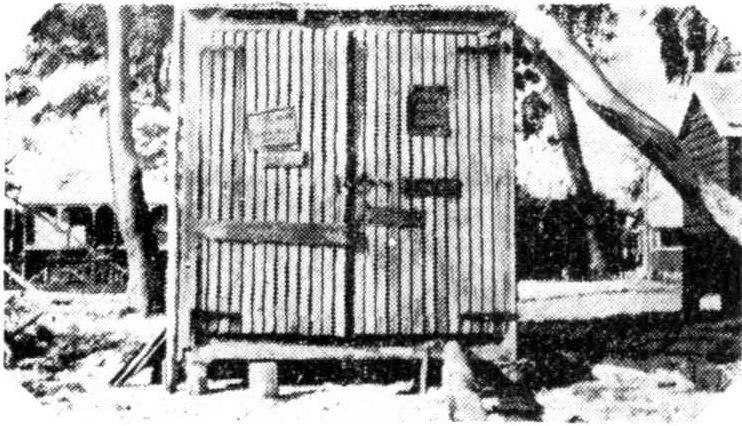
Article caption: Doors of the boat shed decorated with facetious notices
[Bongaree?]
On the following day, in response to our telephonic S.O.S., a motor launch came from Bribie and towed us ingloriously home to find the boat shed will decorated with humourous notices: "Shed for Sale - Owner gone abroad!" "In moments like this you need petrol!"  "Nightly service to Comboyouro!"

The lesson has been learned. Never again will we be caught short on petrol.


SOURCE:
Two men in a boat : The beauties of Caloundra by E.J. S.
Sunday Mail (Brisbane) Sun 30 June 1929 p. 21
http://nla.gov.au/nla.news-article97696700

Wednesday, 13 November 2019

1969 Pumicestone Channel declared a Fish Habitat Area

1969
Pumicestone Channel 
declared a Fish Habitat Area


Did you know it is 50 years since Pumicestone Channel was first declared a Fish Habitat Area? 

Also significant, over 130 years ago Pumicestone Channel was declared a reserve of native birds.

The Pumicestone Passage between the mainland and Bribie Island and most of Bribie Island foreshore, that we all enjoy today, has been known as a fish habitat area for over half a century. Our beautiful waterway is an important nursery ground for our local marine life and sanctuary for native birds and Bribie Island is a flora and fauna reserve.


Pumicestone Passage / Pumicestone Channel in 2012
Source: Qld. Dept. of Environment & Science website


Pumicestone Channel was one of seven areas declared in 1969 as Fish Habitat Areas, the other six areas were Deception Bay, Hay's Inlet, Jumpinpin - Broadwater, Kippa-Ring, Moreton Banks, Myora - Amity Banks.


Declaration dates of significance
23 January 1969 (original declaration of Pumicestone Passage Reserve)
19 November 1983 (original declaration of Bribie Island Reserve)
24 July 1998 (redeclared to cadastral boundaries and to combine Pumicestone Passage and Bribie Island FHAs)
11 November 2011 (redeclared to clarify boundaries and address management issues)

Declared Fish Habitat Area Summary - Pumicestone Channel
Declaration dates as of 2012
Source: NLA's Pandora Archive


Here's to the next 50 years as we continue to preserve our wonderful home.


References:
Declared Fish Habitat Area summary - Pumicestone Channel. Declaration dates as of 2012Available online via NLA's Pandora archive

Declared fish habitat area network assessment report 2012. Compiled by Rebecca Batton, Kurt Derbyshire and Rebecca Sheppard, Fisheries Queensland, Department of Agriculture, Fisheries and Forestry, June 2012. Available online at: https://parks.des.qld.gov.au/managing/habitat-areas/assessment-report.html

Frank Olsen - One Minute Archive.
Queensland State Archives YouTube video available online 
at: https://www.youtube.com/watch?v=wdNFJUGxaMw&list=PLLQLJVDOZ4hXz2MdA0-pD-naz1AdZJofl&index=9&t=0s
Frank Olsen played a key role in developing today's Queensland-wide network of Fish Habitat Areas.

Essay covering reserves for the protection of native birds. Rachael E.V. Marsh.
Queensland Times, Sat 16 Jan 1915, p. 10 via NLA's Trove online
at: http://nla.gov.au/nla.news-article121877576

Sunday, 15 September 2019

1933 Field trip to Pumicestone Passage

The following article was written by Hector Dinning (1887-1941), a distinguished author and journalist. He was born in Maryborough and educated at the Brisbane Grammar School and the University of Queensland of which he was a foundation member. Enlisting in the A.I.F. in 1914, he served in Gallipoli, France and Palestine and was eventually seconded to the War Records Section, where he assisted in the compilation of the official history of the A.I.F. Following wide journalistic experience, on the outbreak of war in 1939 Mr Dinning turned his energies to a wartime occupation to the position of State Publicity Censor.

Easter 1933
Afield with the Bug Hunters
by Hector Dinning

Pumicestone Channel
The Telegraph (Brisbane) Sat 13 May 1933 p. 9
"A company of thirty-two souls - as they say in describing travellers by water - we left Brisbane by the Koopa on Easter Thursday for the Field Naturalists annual camp. ...

About to embark
The Telegraph (Brisbane) Sat 13 May 1933 p. 9
"The steamer that takes the Easter campers to Redcliffe and Bribie is bound to be a bit jammed. We got - after a search what we never expected at that late hour - seats. Both decks were as crammed as a boat of war time refugees. Only the kids looked happy as they slept, which they did early. ...  At Redcliffe, though we disgorged hundreds it made no apparent difference. Such is the growing lure of Bribie, it would seem.

"At Bribie pier we were met by the advance guard of the Field Naturalists, who had gone down by the morning boat, had pitched tents for the females in a one-night camp, and prepared supper for the lot. Having spent the day in this recreational style in God's own sunlight, they were in great form. Infected by this, and heartened by jorums of steaming coffee and Easter buns, we jaded and belated travellers revived a little.

The camp - mess tent and sleeping quarters.
The Telegraph (Brisbane) Sat 13 May 1933 p. 9

"The men, it appeared, were to sleep on the launch that was destined to take the party next day up The Passage to Caloundra, the permanent base of this expedition. A keen wind was blowing and the launch was tossing viciously. It was apparent that, except to those inured to the sailor's life (such as the skipper, his wife and family, stowed for'ard) there would be little sleep afloat that night. So it proved in the event, as related by all but the three of us who had the decision of mind desperately to snatch our sleeping bags from the launch as she cast off and spend the night on the hard, but stable, planks of the jetty. We slept not the less soundly for a notice over our heads that the electric torch revealed: "Camping on this jetty strictly prohibited." ... [on to Caloundra and then back on the Sunday] ...

"We embarked for South Bribie early on Monday. There was lunch and a scramble on South Bribie and a bathe in the easterly surf, and a race back by charabanc over that bizarre, undeviating road to catch the homeward boat. It was stuffed with campers who must at all costs (poor dupes!) be a work on Tuesday morning.

Ocean Beach, Bribie.
The Telegraph (Brisbane) Sat 13 May 1933 p. 9

"When we reached Redcliffe there was standing room only, and when they opened the pier gates the embarking host swept down upon the ship like a flood and swarmed over gangway and ship's side like a horde of boarding pirates. Soon they were standing as thick on the decks as in a London tube during an air raid.

"The engine room telegraph rang out and we began throbbing on the long, long voyage to Brisbane. But over that journey let us draw a veil.

References:
Afield with the Bug Hunters by Hector Dinning. 
The Telegraph (Brisbane) Sat 13 May 1933 p. 9 http://nla.gov.au/nla.news-article168420593

Death of Mr Hector Dinning.
The Telegraph (Brisbane) Mon 24 Nov 1941 p. 4 http://nla.gov.au/nla.news-article172348397

Portrait of Hector Dinning, Brisbane, ca 1930s.
National Library of Australia, image 137952953

Wednesday, 10 July 2019

sailboat Marvel

Tom Tripcony's sailboat Marvel
from Bongaree to Caloundra

Tom Tripcony, a well-known resident of Pumicestone Passage in the early twentieth century, would convey excursionists from Bongaree to Caloundra aboard his sailboat Marvel

Below is a picture of the Marvel and a 1916 description of the journey.


Tom Tripcony's sailboat Marvel, ca 1915
NLA's Trove https://trove.nla.gov.au/version/208823707


"A pleasant way of reaching Caloundra is by water. The Koopa comes to Bribie Sundays and Thursdays, and if one writes beforehand to Mr Tripcony at Caloundra store he will meet the Koopa in his motor launch and land you in Caloundra before 6 p.m. 

The trip [from Brisbane to Caloundra] is thus several hours longer [than by train and motor coach] but it is very enjoyable as Bribie Passage, or Pumice Stone Channel, has its own beauties; and the views of the Glass Houses are very beautiful. At times these weird mountains seem startlingly near, and so many more are seen than from the railway, all different shapes and all eye-arresting." 
[Daily Mail (Brisbane) 4 Dec 1916]

The Marvel was 30 feet long with a 12 feet beam and also delivered stores once a month to the two light towers on North Bribie Island.

REFERENCES
Caloundra: a holiday resort near Brisbane by "Mermaid". The Daily Mail (Brisbane) Mon 4 Dec 1916 p. 7 http://nla.gov.au/nla.news-article215508433

Advertisement for Win Fowles' most modern cash stores. The Brisbane Courier Thu 19 Nov 1908 p. 6 http://nla.gov.au/nla.news-article19550150

Win Fowles [rooster caricature]. The Truth (Brisbane) Sun 6 Sep 1908 p. 5 http://nla.gov.au/nla.news-article206480790

Sailboat Marvel [photo] Sunshine Coast Libraries P87050 accessed via National Library of Australia's online Trove https://trove.nla.gov.au/version/208823707

Sunday, 22 April 2018

1925 Bribie Island The Rising Resort

The following advertorial appeared in the 1925 brochure entitled Mountain and Seaside Resorts from Noosa to Tweed which was compiled and issued by the state Tourist Bureau. 


Bribie Island The Rising Resort
December 1925

Bribie Island, or Bribie, as it is more conveniently called, is reached by continuing the steamer trip in the s.s. Koopa or Doomba past Redcliffe to its furthest limits. It is 38 miles from Brisbane, and is reached after a three hours run from the city, the steamers berthing at a short, well-constructed jetty. Bribie Island and Moreton Island, which lies opposite at a considerable distance, form the most northern outposts of Moreton Bay. Bribie Island is about 20 miles long, from 2 to 3 miles broad, and is well timbered.  

Near the jetty there is a commodious refreshment-room, where fish and oyster dinners are obtainable, and also stores at which campers can purchase requisites. A large pavilion, bathing-sheds, and other conveniences for the use of visitors have been erected. Accommodation is provided for by a number of boarding-houses, and, as a further inducement, the steamship company has erected twelve huts of a standard design and size (14 feet by 12 feet) along the inner beach. 

On application to the caretaker, Bribie, these may be let at the following rates:- Ordinary weekly tariff, 6s.; Christmas, New Year, and Easter, 10s. per week; week-ends, 3s. 6d. 

For the excellence of its fish and oysters, Bribie is known far and wide, and during the summer months the company run their steamer to Bribie every alternative Saturday to afford city folk and anglers an opportunity of a week-end at this resort. 

The Amateur Fishermen's Association has erected a fine cottage for the convenience of members. It is situated about half a mile from the jetty. 

Bribie has made rapid and substantial progress during the past two years. An excellent road has been constructed from the jetty across the island to the Ocean Beach, where a handsome and commodious kiosk has been erected by the Brisbane Tug and Steamship Company for the convenience of visitors. 
The main ocean beach is ideal for surfing, and excellent fishing may be enjoyed nearly all the year round. This beautiful hard sandy beach stretches for miles along the eastern side of the island. Motor 'buses meet all steamers and convey passengers to the ocean beach.

 There is a Government experimental station a short distance from the jetty. Visitors will receive much assistance and useful information from Mr. Bob Davies, at his store near the jetty.


Travelling from Bongaree to Caloundra through Pumice Stone Channel
December 1925


Caloundra can be reached by a through smooth trip from Brisbane. The glimpses of scenery obtained during the passage through the winding channel are such that must be seen to be appreciated. Leaving Bribie, Toorbul Point, on the mainland, is passed; thence the old fish-canning works. Presently an old iron hulk is viewed; then are seen what appear like fenced selections on the sea, which are really licensed oyster banks protected by this means against the enemies of the shellfish.

Looking further northward one perceives the green-carpeted sward of the banks on which hundreds of aquatic birds, from the large pelican to small snipe, are peacefully feeding, whilst further away great flocks of black swans are gracefully swimming.

Ever and always about us are the towering peaks of the Glass House Mountains, their grey trachyte sides viewed first from the south-east, thence due east, and again from the north-east. By proceeding from the metropolis to Caloundra Via Bribie, and returning via Landsborough by rail to Brisbane, or Vice versa, a splendid round trip is afforded tourists.

REFERENCE:
Mountain and seaside resorts from Noosa to Tweed. (1925) Compiled and issued by The Queensland Government Intelligence and Tourist Bureau, 10 December 1925. Bribie Island the rising resort [text and photos] pages 94-94. Travelling from Bongaree to Caloundra through Pumicestone Channel [text and photos] pages 67-70. Viewed on the Internet Archive https://archive.org/