Showing posts with label Toorbul Point. Show all posts

Friday, 1 May 2026

1908 Blown across the Bay

Residents of Brisbane and surrounds enjoyed a public holiday in the years 1901 to 1909, on November 9th for the King's Birthday (during the reign of King Edward VII). Many excursionists took the opportunity to visit the islands in Moreton Bay. The following story details a group of friends out for a sail "on the Bay" over the 1908 King's Birthday weekend, and their unexpected visit to Bribie Island.

Blown across the Bay. Exciting experience at night.
Six hours in a south-east gale.
Cast up on Bribie Island. 
1908 

The crew of the 18-foot sailing boat Osprey are not likely to soon forget their experiences in the south-east gale which raged at the commencement of last week.  The Osprey left Bulimba on Saturday afternoon, November 7, in charge of W. Peters, who had with him Messrs. P. Brunt, G. Rees, and L. Stephens, and a course was set for Wynnum, where that evening Mr. W. Dewick joined the party followed on Sunday morning by Mr. C. Fawcett. The Osprey afterwards set sail for Peel Island, which was reached without incident during the afternoon, and the boat was anchored in the "gutter" on the northern side of the island. As the shades of evening fell a strong south-east wind commenced to blow, increasing in velocity to a strong gale. Having looked to the moorings, and feeling confident that all was safe, the crew remained on board. Rain fell heavily, but being, as they thought, quite secure, the crew paid little attention to the storm. At 8 o'clock, as they were about to retire for the night, the Osprey began to bob about in a most violent manner, and, according to a statement made by Mr. Fawcett, it was suddenly discovered that the anchor rope had given way, and that the craft was adrift.  

To return to Peel Island against such a strong wind was impossible. Cleveland Light was seen on the port quarter, and a light from a boat on Peel Island was visible astern. It was at once decided to try and reach Wynnum, as the wind and sea were increasing in force every minute. The small boat, with a storm jib out, which had knots tied in each corner, simply flew before the wind. The night was very dark, but despite this it was confidently expected with the aid of the lights to make Wynnum safely. Very soon, however, the lights were lost sight of, and the crew lost their bearings. The rain continued, the men being unable to see each other, and compelled to continually call out to ascertain if all were safely on board. Mr. Peters managed the boat with great skill as it dashed across the storm-tossed water in the darkness, every one having to hold on to anything available for fear of being tossed overboard. One or two lights were seen after losing sight of that at Cleveland, but the men were unable to locate their position. One light they thought was Tangaluma, but they were not sure. Two or three times they thought they saw land, but it was only the continual roll of the sea in front of the boat. About 2 o'clock the boat crossed over three rips. This was a very anxious time, as every moment was expected to be their last. 

About 2.30 a.m. land came into view, straight ahead, and Mr. Peters decided to run the boat ashore. This was successfully accomplished without in the least way straining the boat or losing anything overboard, and the crew lost no time in jumping on to the beach to secure the Osprey. Thoroughly exhausted after their six hours’ battle with the elements, the men secured their wet blankets, which they wrapped round themselves, and throwing themselves on the ground slept till daylight.  

When the sun rose it was discovered that the boat had brought up at Skirmish Point, Bribie Island, and the crew then realised what a lucky escape they had had from being blown out to sea.  Soon after sunrise Messrs. Peters and Stephens started out to the Caloundra Canning Company’s works, four and a half miles away, and they returned to the party about 1 p.m. with the information that accommodation had been found.  

Houses at The Devil's Elbow, Bribie.
Photo: Queenslander 8.9.1906

The party were well looked after by the people at the works, who went to no end of trouble to make them comfortable.  The following Wednesday morning the party, who were still dressed in their boating costume, and were without boots, were rowed across Bribie Passage and landed at Toorbul Point, whence they set out to walk to Caboolture, eighteen miles distant. They arrived at Caboolture footsore and weary at 2.30 p.m. Mr. Fawcett said they were without money, and, as they say, applied to the official at the railway station for a pass to enable them to take train to Brisbane, but this was refused, despite the fact that they related their experiences of the previous days. They then made application for assistance to the local sergeant of police, who wired to Brisbane, and that evening a reply was received giving instructions for a pass to be issued to them.

Mr. Fawcett said that great praise was due to the way Mr. Peters handled the boat under such trying circumstances, and the crew very much appreciated the kindness extended to them at the Caloundra Canning Company’s works.  He added that before leaving Bribie Island arrangements were made with Mr. Buckley, a well-known fisherman, for the purchase of the Osprey.

REFERENCES

Houses at The Devil's Elbow, Bribie [PHOTO]
The Queenslander, Sat 8 Sep 1906, p. 26. http://nla.gov.au/nla.news-article25969137

Blown across the Bay.
The Brisbane Courier, Tue 17 Nov 1908, p. 5 http://nla.gov.au/nla.news-article19549869

Friday, 31 October 2025

1923 Racehorse named Bribie

One hundred years ago, there was a racehorse named Bribie, owned by James Clark. James Clark and his family owned the Toorbul Point property for most of the twentieth century, the land now being the location of the suburb of Sandstone Point. 

A Racehorse named Bribie

Photo: Berry and Whalley.
The Telegraph 1.6.1923 p.4

This is Bribie, who, like Lady Aura, will represent Sydney in the Stradbroke Handicap [in 1923]...  Bribie, however, is owned by a Queenslander in Mr James Clark, but has done all his racing in Sydney.  He also is engaged in the Sires' Produce Stakes.  

Bribie is a nice-looking colt out of Kummulla, and was bought by his present owner, Mr J. Clarke, for 800 guineas. Mr Clark named him after an island in Moreton Bay, Queensland.

Bribie has only started twice, but it would be strange if he could not gallop for he is a brother to that brilliant sprinter, Glenacre. His dam, Kummulla, . . . This family has been a very successful one, having produced countless good performers. Bribie finished in impressive style, and in this colt there is every probability of Mr Clarke having another Tangalooma. 


J. Clark’s Bribie winning the Claret Stakes from Ardglen and Belle of Crecy.

Photo: King Arnold
The Telegraph 11.6.1923 p.4

Mr J. Clark's Bay Colt Bribie, winner of the Claret Stakes at Ascot on Saturday last, about to be swung aboard the Kanowna yesterday on his way to Sydney.  

Photo: Berry and Whalley
The Brisbane Courier 12.6.1923 p.16

Mr James Clark (1858-1933) "nothing but the best"

From his obituary 10.7.1933: "In his day Mr. Clark was a famous yachtsman, and right up to the close of last season’s sailing calendar he could be found regularly every Saturday following with the closest interest the sailing races on the Brisbane River, sometimes in his own launch, but more often on the flagship of one of the clubs.  He was a sound cricketer, one of the best rifle shots in Australia, and did not neglect the turf, for he owned many good racehorses.  It was characteristic of Mr. Clark that he had but one standard for his varying diversions, and that was “nothing but the best”."

REFERENCES

Bribie. [Photo] This is Bribie, who, like Lady Aura, will represent Sydney in the Stradbroke Handicap on Saturday.  Photo: Berry and Whalley.
The Telegraph, Fri 1 Jun 1923, p. 4 http://nla.gov.au/nla.news-article177041048  

J. Clark’s Bribie winning the Claret Stakes. [Photo] Photo: King Arnold
The Telegraph, Mon 11 Jun 1923 p. 3 http://nla.gov.au/nla.news-article177042928 

Shipping a racehorse. [Photo] Photo: Berry and Whalley.
The Brisbane Courier, Tue Jun 12, 1923, p. 16 http://nla.gov.au/nla.news-article20627185 

Racehorse Bribie owned by James Clark.
Referee (Sydney) Wed 13 Dec 1922, p. 7 http://nla.gov.au/nla.news-article127923486

Obituary. Mr James Clark (1858-1933)
The Brisbane Courier, Mon 10 Jul 1933, p. 10 http://nla.gov.au/nla.news-article22193812 

Thursday, 31 July 2025

1900 Cruising yachts

 The following article describes a cruising yacht race from Brisbane to Toorbul Point and back, over the weekend of 8-9 December 1900. Between the two legs of the race, an afternoon and evening were spent at Toorbul Point, where the team-members participated in a cricket match and later an impromptu concert.

Aquatics. Queensland Yacht Club. Cruising Races

Weekend at Toorbul Point

8-9 December 1900

. . . . After finishing the race the boats proceeded across to the residence of the club's commodore, Mr. James Clark, at Toorbul Point, Bribie Passage, where they joined a number of other club boats, which had preceded them. Most of the boats sailed across to Bribie Passage by moonlight, and the sail was described as being a beautiful one. 

Next day the Q.G.S. Albatross, with the Hon. E.B. Forrest and a party on board, arrived about 1.30. In the afternoon an interesting and highly-amusing cricket match took place between teams captained by the commodore, Mr. James Clark, and the vice-commodore, Mr. W.A. Douglas. 

The vice-commodore’s team batted first, and scored 63, the principal scores being : Fox 17, Douglas 12, Hunt 7, Harvey 7, and Warry 1. The other side only compiled 29, of which 11 were made by Gray, Westaway compiling 6, and O’Beirne 2. 

After tea a very pleasant evening was spent on board the Albatross, when an impromptu concert was organised, some very good items being rendered by the following gentlemen : Messrs. D.B. McSwaine, G. Barnett, Gray, Arthur, F.J. Macgillycuddy, G. Warry, and others, while Mr. G.C. O’Beirne accompanied a number of the songs, and gave selections on the banjo. 

Clianthus cruising yacht

The following boats anchored at Toorbul Point on Sunday night: Harriette Ann, Viking, Ida, Vixen, Clyanthus, Maroma, Gondolier, and Balmoral. 

Gondolier cruising yacht

The second of the cruising races was run, the course being from Toorbul Point to the Pile Light. The wind was very light, from east-north-east, at the start, which took place at about 11 o’clock. The give-flag system was again used for starting, and the start was a perfect one, the boats getting away well … . The wind was very variable, but the boats were enabled to lay the course with eased sheets. … . At the finish the times were : Gondolier, 1h. 34min. 40sec. ; Viking, 1h. 37min. 44sec.; Ida, 1h. 39min. 47sec.; Harriette Ann, 1h. 44min. 2sec. ; Clyanthus, 1h. 47min. After the handicaps had been adjusted, the corrected times order was : Viking ; Gondolier ; Ida ; Clyanthus, Harriette Ann.

All the boats returned to their moorings early, after having spent a most enjoyable outing.

REFERENCES

Aquatics. Queensland Yacht Club. Cruising Races.
Brisbane Courier Tue 11 Dec 1900, p. 7. https://trove.nla.gov.au/newspaper/article/19082818

Sailing as a Pastime in Brisbane.
Sydney Mail and New south Wales Advertiser 28 Jan 1903 p. 217, photos 9. Clianthus 10. Gondolier https://trove.nla.gov.au/newspaper/article/163777544


FURTHER READING

Government Steamer Albatross
Brisbane Courier 16 Sep 1903 p. 7 http://nla.gov.au/nla.news-article19241952

Obituary for Edward Barrow Forrest (1838-1914)
E.B. Forrest "assisted in the formation of the Royal Queensland Yacht Club, on which he was president for many years."
Telegraph (Brisbane) Tue 31 Mar 1914, p. 8 http://nla.gov.au/nla.news-article174274105

Friday, 28 February 2025

1943 'N' Battery on Bribie Island

The following description is from the reminiscences of Major Ronald Dryen (1916-2003) published by Reg Kidd and Ray Neal in 1998. Major Dryen's first-hand account of 'N' Battery's camp on Bribie Island offers a brief glimpse of life on the island in 1943.

'N' Battery camp, Woorim, 1943.

"There was an American training camp for amphibious operations on Toorbul Point on the mainland opposite the southern tip of Bribie Island. When 'N' Battery was ordered to move to Bribie Island I prevailed on the Amphibious Warfare Unit to lay on a Landing Craft Surf (LCS) for a reconnaissance of the Bribie Island shoreline. The LCS was a water jet-propelled craft with shallow draft and no propeller, particularly suitable for landing on beaches. An adaption of this craft was used later on Australian beaches as surf rescue boats.

Normally Bribie Island could only be reached by a small motor boat operated by an Australian Small Ships Unit across the northern end of the Pumice Stone Channel, and by the American Unit at Toorbul Point at the southern end. After the war a bridge was built across the southern channel.

After three or four landings through the surf at various points I selected a site for the battery just north of the Welsby Lagoon, about midway along the island's shoreline, between Bribie and Skirmish Batteries.

In late March 1943 'N' Battery moved by road from 'Tabragalba' via Caboolture, to Toorbul Point where it was embarked on Landing Crafts Tank (LCTs) and transported by the American Amphibious Warfare Unit around Skirmish Point to its new location. It was our first experience for a beach landing, but not withstanding a narrow beach and a 3-feet escarpment, there were no hitches.

The battery was fortunate in that among its talented and resourceful soldiers it had a gun sergeant who had been an architect in civilian life and a gunner who was on strength as a carpenter. As soon as all the stores were unloaded from the LCTs the BSM took out a foraging party which after two days' search of the interior of the island and on the mainland returned with an adequate 'collection' of timber, sheet iron and other materials. Designed by the architect and constructed by the carpenter with a few officers, we soon had a BOP, storerooms, ammunition recesses, mess huts, kitchen, ablutions and a latrine block. The CASL Section under the Searchlight Officer dug a well about 50 yards in from the beach and set up the petrol motor water pump. After a few days' pumping it produced crystal clear fresh water sufficient for all our needs. The camp lacked electricity and we had to make do with hurricane lamps, which attracted all sorts of insects at night; otherwise we were fairly comfortable. Rations were picked up weekly from the DID at Woorim. There were no roads on Bribie Island and the only means of transport on the island was by running the jeep or 15-cwt truck along the beach front at low tide.

Map : Brisbane Fortress 1943
source: page 350, Kidd & Neal (1998) The 'Letter' Batteries.
Map developed from a map in the unpublished draft The Guns of Brisbane and Moreton Bay prepared by
Major Roy Harvey and Brigadier R.K. Fullford, OBE, for the Royal Australian Artillery Historical Society Inc., Manly, N.S.W.
Reproduced with permission of RAAHC (previously known as the RAAHS) 26.2.2025

Apart from the foot injury suffered by the beach piquet during the initial landing, the troops were free from sickness and serious injuries. The cooks found a snake wandering around the precincts of the kitchen. They killed it and draped it over a clothesline as a warning to others. One inquisitive soldier lifted up the snake's head to have a better look and the snake, obviously not yet dead, promptly bit him. He was quickly attended to by the Medical Orderly, Cpt. "Happy" Walkington, AAMC.

Foraging parties were a frequent form of recreation on off-duty days. One such party found a small rowing boat, launched it on the lagoon in the middle of the island and offered to take me for a ride in it. On disembarking I put a bare foot in the water and trod on a submerged broken bottle. Bleeding profusely I was carried back to the camp and rushed by jeep to Woorim where there was a fully equipped Casualty Clearing Post. The corporal medical orderly cleaned the wound and put in a few stitches using a pair of pliers to pierce the tough skin of the ball of my foot. On return to camp, the carpenter kindly fashioned me a pair of crutches. After a couple of weeks the wound turned septic and I had to call a doctor over from the mainland. He removed the stitches and put me on a course of sulphonamides. Shortly afterwards the main item at a concert party put on by the troops consisted of a soldier impersonating the BC being carried on the back of another, with a foot swathed in bandages, rushing up and down the stage ordering all and sundry to do this and that.

Being near the outlet from Brisbane to the Pacific Ocean, there was practically an endless stream of shipping passing the front of the battery. The personnel were able to get plenty of practice on the equipments by day and by night and to experience the coast artillery watch system on continuous manning. I had the carpenter make a miniature range, simulating the splashes of shells on the water, and I was able to train the officers in observation of fire and ranging procedures.

While performing the pre-dawn preparation for action one day we noticed a distinct reddening of the sky to the south-east in the direction of Moreton Island, followed by an audible explosion. Some days later we learned that the phenomena were caused by the torpedoing of the Australian hospital ship Centaur at 0410 hours on 13 May 1943.

In July 1943 'N' Battery packed up and moved out of its site on Bribie Island."

REFERENCES AND ACKNOWLEDGEMENT

The Story of 'N' Aust Heavy Battery, as related by Major Ronald G. Dryen (Retd) - The Battery Commander, pages 290-292, In: The 'Letter Batteries' : the history of the 'Letter' Batteries in World War II by Reg Kidd and Ray Neal, Sydney: published by the authors, 1998. ISBN 0 646 35137 0

Map : Brisbane Fortress 1943. source: page 350, Kidd & Neal (1998) The 'Letter" Batteries. Map developed from a map in the unpublished draft The Guns of Brisbane and Moreton Bay prepared by Major Roy Harvey and Brigadier R.K. Fullford, OBE, for the Royal Australian Artillery Historical Society Inc., Manly, N.S.W. Reproduced with permission of RAAHC (previously known as the RAAHS) 26.2.2025

With thanks to the Royal Australian Artillery Historical Company (RAAHC) formerly the Royal Australian Artillery Historical Society Inc. (RAAHS) https://www.artilleryhistory.org/ for permission to reproduce the Map Brisbane Fortress 1943 on this blogpage. 26.2.2025 

Brigadier R. K. Fullford OBE (1918-2006)
https://artilleryhistory.org/gunners_past_and_present/gunners_of_renown_and_gunners_tales/gunners_of_renown/chapter_4/documents/bio_fullford_richard_kennedy.pdf 

Roy H. E. Harvey (1919-1994)
https://artilleryhistory.org/gunners_past_and_present/obituaries/obituaries_h/roy_henry_harvey.pdf

FURTHER READING

1942 Troops train on Island https://bribieislandhistory.blogspot.com/2024/10/1942troopstrainonisland.html 
Troops Train for Offensive Landings by M.C. Warren, "Telegraph" War Correspondent. The Telegraph 2.12.1942 p. 4 http://nla.gov.au/nla.news-article172598227

Bribie Island WW2 Fortifications https://bribieislandhistory.blogspot.com/2016/11/bribie-island-ww2-fortifications.html

Online catalogue for Cutler Research Centre https://ehive.com/collections/201005/cutler-research-centre

Saturday, 26 October 2024

1942 Troops train on Island

The following article, written in 1942, has a description of the military activities at Toorbul Point and Bribie Island, though neither place is mentioned as was the practice during wartime to keep information, about military training operations, restricted. 

Troops Train for Offensive Landings (1942)
by M.C. Warren, "Telegraph" War Correspondent. 
The Telegraph 2.12.1942 p. 4

An island off the Australian coast a popular holiday resort in peacetime - now is the centre of the most intensive amphibious training ever given to troops in this country.

Thousands of Australian and American soldiers have learnt there a new technique - seamanship - at an Australian Army Combined Operations School. There is a very good reason why our military leaders want to make troops amphibious-minded. 

War in the Pacific made many of our earlier training methods obsolete overnight. It meant a substitution of jungle methods of combat in place of open fighting in which 'block' formations and weight of armour counted. Our troops mastered jungle tactics and beat the Japs back in New Guinea. 

Now our military strategy is no longer defensive, it is offensive. It is not a case of 'hold what we have', but 'take back from the Jap'. This means carrying the war over the sea to the islands of the Pacific. Troops must be trained to lose any fear of moving over water, to handle small boats and to embark and debark swiftly and efficiently. They must learn about tides, currents, and winds. They are shown how the tide can be used to reduce the fatigue of paddling. They must become 'mud minded' - a tactical surprise can be achieved by a landing in swampy mangroves. Defence of small watercraft from hostile aircraft also is a phase of training. 

Already large numbers of troops have mastered these and other lessons at the island close to the coast.

Troops train on island
photo source: BI Surf Club book, 1988, p. 95

The Navy and the Air Force combine with the Army in making the course as tough and as thorough as training could be. All three services have a part in the operations, just as they would have in actual battle. All of the Army instructional staff are AIF personnel with practical experience in this war. Three American officers are attached to the school. Naval officers give lectures on seamanship and kindred subjects and the Navy also provides and runs the watercraft. 

An Army Co-operation Squadron joins in the exercises, either as friendly or hostile aircraft as required by the situation. Both Navy and Army officers make air flights as part of their training.

Embarkation

A first-hand picture of the wide scope of the school's activities was given to visiting war correspondents. They saw an American combat unit in action. Their mission was to land and attack a hostile beach position on the island off the coast. Primarily, they were required to take an airfield from the 'enemy.' Live ammunition and bombs are used in the exercise. The presence of aircraft gives realism to the task. Shortly before zero hour for the beach landing, Allied aircraft raided the 'enemy' airfield on the island, diving in concentric attack upon dummy planes, installations and troops. They dropped live bombs ranging from 112 lbs to 250 lbs. A smoke screen was laid down by fast motor boats for the landing. The assault troops fixed bayonets. Towing ropes were cast off and the first wave of infantry was paddling vigorously towards shore through the smoke.

Realism

Mines blew up in the water around them showering the troops with gushers of water. Hostile aircraft dive bombed the landing boats, simulating machine gun fire. The troops responded with fierce ack-ack bursts from Tommy guns and rifles. Friendly aircraft beat off the air attackers and formed a protective umbrella. The boats grounded on the sand. With a quick rush, the troops were across the beach, engaging the defenders. More mines blew up around them, giving the impression of heavy 'enemy' shelling. 

By infiltration, the first wave of troops ashore routed the shore defenders and pushed inland. Second, third, and fourth waves of infantry went ashore in quick succession and consolidated the beachhead. Parties were sent out to protect the flanks. A motor propelled barge came in sight, bringing jeeps and mobile anti-tank guns. The barge stood in close to the beach, a ramp was lowered and the jeeps splashed through the shallow water on to dry sand, hauling the anti-tank guns. The 'enemy' had blocked the only cleared ground leading from the beach with huge fallen trees. Engineers tackled the problem and within a few minutes a track was ready for the jeeps to bring the anti-tank guns up the rise.

Encirclement

They enveloped the airfield so successfully that a wallaby, caught on the landing strip was unable to escape through the ring of attackers. The word 'withdrawal' is not in the vocabulary of our military training school nowadays. When this unit had to return to their camp they did not merely withdraw, but performed another training operation. Main training at the school is in movement by night. Beach landings in hours of darkness are considered essential for surprise tactics.

Dispersement

The school does not put troops immediately into water manoeuvres. They practice beach assault first from dummy boats at the waters edge. Special tactics taught at this stage are dispersement, speed, silence and method of moving the craft.

Despite the element of risk associated with the rigorous training methods at the school and the many thousands of soldiers who have passed through it, not one serious accident has occurred.

REFERENCE
Troops Train for Offensive Landings by M.C. Warren, "Telegraph" War Correspondent. The Telegraph 2.12.1942 p. 4 http://nla.gov.au/nla.news-article172598227

Photo source: Bribie Island Surf Club Book, 1988, page 95.

FURTHER READING
Merv Warren (1914-2013) War Correspondent: As I saw World War II. 1993. 106p. ISBN 0646149652 

Saturday, 27 July 2024

1947 Road to Toorbul Point jetty

An article about the road to Toorbul Point covered with felled trees and beehives in February 1947.

Bees and Trees Bar Toorbul Point Road

Courier Mail 21.2.1947 page 5

These felled trees completely blocked a road leading from Caboolture to Toorbul Point, 40 miles north of Brisbane.

Trees bar Toorbul Point Road - February 1947
Photo: Courier Mail 21.2.1947 p. 5

The road, which was constructed by the army during the war, runs partly through private property and partly through council land at this point.

Leading through to a jetty from which mail is shipped over to Bribie Island, this section of the road is at present by-passed by a rough track twisting through trees.

The Caboolture Shire Council has plans before the Lands Department for the resumption of the land which includes the road.

Beehives On Way

On the approach to the road from the jetty these bee hives (below) owned by Mr. O. Bestman, through whose property the road passes at this point, bar the way.

Beehives bar Toorbul Point road - Feburary 1947.
Photo: Courier Mail 21.2.1947 p. 5

Mr. J. C. Clark, through whose property the road also passes near this point, said last night that he could not comment on either the block or the proposed resumption at this stage.

The Caboolture Shire Clerk (Mr. S. Lang) said yesterday that a survey of the road from Caboolture to Toorbul Point had been made. It had been found that the military road was the most suitable and most practical route to the point.

A great deal of the council's money would also be saved.

REFERENCE

Bees and Trees Bar Toorbul Pt Road. Courier Mail 21.2.1947 p. 5
[Via Trove]: http://nla.gov.au/nla.news-article49362320

Saturday, 29 June 2024

Road to Toorbul Point

 The following letter to the editor dated Sep 1926 was sent by James Clark (1857-1933) regarding the question of a road to run through his property at Toorbul Point thus allowing public access to the Bribie Passage and at the same time not interfere with his business at Toorbul Point.
In his letter to the editor James Clark refers to a sketch of the road on a map of the district which accompanied his letter dated 28 July 1926 to the Caboolture Shire Council.

Road to Bribie.

Letter dated Sep 1926 by James Clark
to the editor of the Daily Mail (Brisbane)

Sir, - For some time past the question of a road to Toorbul Point to give access to Bribie Island has been under consideration by the Caboolture Shire Council. For the information of those interested I may state that the following letter offering a road was sent by me to the Caboolture Shire Council on July 28:

“Re Toorbul Point road: Some time ago a deputation waited on the council and petitioned that a road be opened through my property at Toorbul Point. After various visits to the Point by the council and inspections by the council engineer, it was decided by the council to let the matter rest in abeyance.

Building on James Clark's property, Toorbul Point.
Daily Mail 16.12.1924 p.16
“Since then I have been approached by several residents and people interested in Bribie Island, and have promised to write to the council with the object of having a road made available that would give access to Bribie Passage and at the same time not interfere with my business at Toorbul Point. With the object, therefore, of obtaining the council’s assistance in the matter, I enclose portion of a map of the district under discussion with a proposed road sketched on it that I think would be satisfactory to all concerned. I would erect at my own cost the fence shown on the map. I would lease the land on the northern side of the fence to the council for road purposes for say 29 years, at a nominal rental. I would donate £100 towards the expense of making the road. I retain all rights of the land, with the exception of the easement for road purposes granted to your council.

“No buildings, with the exception of a shed at or near the proposed jetty to be erected without my permission.

“The public telephone at present at my cottage at Toorbul Point to be removed and placed in the shed at the proposed jetty. The council to clearly mark the new road to Bribie Passage with suitable signposts so as to avoid any mistake being made and also to assist me in closing the present private track.

“I would also ask your council to definitely accept or refuse this offer within three months from the present date, and, should the council accept, to be prepared to start the work on the road immediately. Should the council wish to discuss the matter with me, I would be pleased to attend a council meeting.”

No doubt those interested will perceive that I do not wish to prevent the public from getting access to Bribie Passage provided my business and valuable oyster leases at Toorbul Point are not interfered with. The road proposed by me leads to the passage at Ninghi Creek Point, where there is the deepest water to be obtained anywhere around the property, and where the expense of erecting a suitable jetty would be very little. I may say that up to the present no reply has been received by me from the Caboolture Shire Council,
Yours, etc., JAMES CLARK (per J.C. Clark).

Source: Letter to the editor "Road to Bribie" by James Clark (per J.C. Clark). The Daily Mail (Brisbane) Wed 22 Sep 1926 p. 3 http://nla.gov.au/nla.news-article218338906 

Further Reading

Patricia Mercer, 'Clark, James (1857–1933)', Australian Dictionary of Biography, National Centre of Biography, Australian National University, https://adb.anu.edu.au/biography/clark-james-5664 published first in hardcopy 1981, accessed online 30 June 2024.

Monday, 27 May 2024

Bribie Passage Estate - 1962 - Ningi Creek - Toorbul Point

The lots of land mentioned below were first offered for sale in 1920 and advertised as The Koopa Estate. In 1962 construction began on the new Bribie Island Bridge and the final stage of the bitumen road to Toorbul Point increasing the potential interest in building holiday homes in the area.

Bribie Passage Estate, Toorbul Point - in 1962

158 lots - the estate would later become known as the township of Ningi

Follow the Bruce Highway to Caboolture. Turn right at the Caboolture Post Office and continue on along the new Toorbul Point Road...

This is the resort area of amazing potential - The Bribie Bridge, unlocking the island playground, is already nearing completion. Work on the final stage of bitumen road to Toorbul Point is now underway, and will be completed within two months. 

Land already in strong demand - last year the first section of this estate (consisting of 140 blocks) was sold out within a few weeks.

Only 35 miles from Brisbane - less than an hour's drive on bitumen roads from Brisbane...

from a full page advertisement for
Bribie Passage Estate Toorbul Point
source: newspaper 12 May 1962

No finer fishing, swimming, boating - Bribie Passage has long been recognised as one of the finest fishing grounds in the State. ... Swimming enthusiasts may choose between the white sandy sheltered beaches of the Passage, or make the two-mile bitumen run to the ocean-side surf.

Managing Agents: Ross McCowan, Queen Street (next door Allan & Stark), Brisbane.

Source: Full page advertisement by Ross McCowan, newspaper 12 May 1962

Related article:
The Koopa Estate - 1920 - Toorbul Point - Ningi Creek

Saturday, 27 January 2024

The Koopa Estate - 1920 - Toorbul Point - Ningi Creek

Over a century ago, in 1920, 18 lots of land were offered for sale in "The Koopa Estate" which was described as "situated on Toorbul Point, frontage to Ningi Creek". The following advertisements give details about these 'seaside farms'. 

The items below refer to accompanying lithographs - if you have a copy of a lithograph of the Koopa Estate from 1920 please send us an email at bribiehistoricalsociety@gmail.com 

The Koopa Estate. For Sale.  [Large advertisement] 18 Beautiful Farms, 30 to 85 acres each. Situated on Toorbul Point, frontage to Ningi Creek, within half an hour’s trip by motor boat from Bribie Island.  Ideal citrus, pineapple, and banana land, splendid dairying country.  All subtropical products grow to perfection.  This is an exceptional opportunity to secure a Seaside Farm, in the beautiful locality, easy terms, only 1/10th deposit, 9 years for balance.

The Koopa Estate. For Sale.
18 Beautiful Farms, 30 to 85 Acres Each
The Telegraph 23 December 1920 p. 10

The numerous products of the adjoining lands are well known to the large crowds of Bribie visitors. Buyers can inspect this fine Estate by motor boat, leaving Bribie Jetty at 8 a.m. on Wednesday and Thursday, 29th and 30th December, or by application to the agents from Caboolture. Lithographs, further information and prices obtainable from Morton & Davis, Property Salesmen, 298 Adelaide Street (opp. Howard Motor Coy.), Brisbane and Caboolture or from the Office of the Brisbane Tug Company, and from J. Campbell, Bribie
Source: The Telegraph 23.12.1920 p. 10 http://nla.gov.au/nla.news-article179641560

KOOPA ESTATE, TOORBUL POINT.

Koopa Estate, 18 beautiful mixed Orchard and Dairy Farms, situated on Toorbul Point, handy to Bribie Island, or by road to Caboolture; £4 to £8 per acre. 9 years’ terms. Morton & Davis, Property Salesmen, Caboolture.
Source: The Daily Mail, 28.12.1920 p. 8 http://nla.gov.au/nla.news-article212821088

The Koopa Estate.
Choice farms, 30 to 85 acres,
each situated on Toorbul Point,
30 minutes by motor boat from Bribie.
Splendid fishing and boating.
The Telegraph Sat 29 Jan 1921 p. 16

REFERENCES

The Koopa Estate. For Sale. [Large advertisement] 18 Beautiful Farms, 30 to 85 acres each. Situated on Toorbul Point, frontage to Ningi Creek, within half an hour’s trip by motor boat from Bribie Island. 
The Telegraph Thu 23 Dec 1920, p. 10 http://nla.gov.au/nla.news-article179641560 

The Koopa Estate. [Large advertisement] Choice farms, 30 to 85 acres, each situated on Toorbul Point, 30 minutes by motor boat from Bribie. Splendid fishing and boating.
The Telegraph Sat 29 Jan 1921 p. 16 http://nla.gov.au/nla.news-article180542027

Koopa Estate.
The Telegraph Thu 23 Dec 1920, p. 10 http://nla.gov.au/nla.news-article179641560

Koopa Estate, Toorbul Point.
The Daily Mail Tue 28 Dec 1920, p. 8 http://nla.gov.au/nla.news-article212821088

Related article:
Bribie Passage Estate, Toorbul Point - in 1962

Monday, 17 January 2022

1919 Holiday at Bribie

 1919 First two weeks of January

Holiday at Bribie

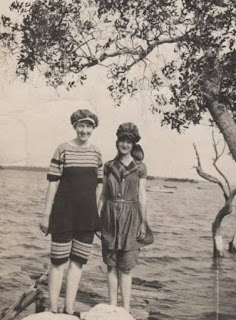
On Wednesday 1 January 1919, Elsie Jones (19) and her aunt Ivy Campbell (21) were staying at Toorbul and went across to Bribie Island to see the Beaver arrive and wave goodbye to one particular passenger returning to Brisbane. These details are recounted by Elsie in her diary which has been kindly shared with BIHS by her family.

For Elsie and Ivy, 1st January was a public holiday known as Commonwealth Day. They had travelled from Brisbane to Toorbul on the previous day and may have attended the concert that was held on Bribie on New Year's Eve.

The concert on Bribie had been arranged by a committee comprising Messrs. R. Davies, H. McLeure, T. Marshall, T. Carberry, F. Brockley and P. Daunt (chairman) and Miss Ackworth (pianist), for the benefit of the Ambulance Brigade and the St John's Ambulance. A newspaper article reported that 400 people attended the concert, the majority of whom were campers staying on Bribie Island for the holidays.


QUEENIE  JONES  DIARY  1919 JANUARY

1 WEDNESDAY        Commonwealth Day – Public Holiday
Ivy & I landed at Toorbul yesterday.  All of us went over to Bribie in motorboat in morning to see the “Beaver” in, & to see Pte. Davis off.  In afternoon Ivy & I took books up into a tree on the beach – scrumptious.  Then had a yarn (revelations) to Miss Shepherd, & came to bed straight after tea.  Scrummy day!

2 THURSDAY
Went over to Bribie again today.  Met Mrs. Dickson & had lunch there.  In afternoon, Ivy & I went up into tree on beach & wrote poetry!  People next door put telescope on us & also camera.  Miss Shep., Ivy & I walked on jetty at night.

3 FRIDAY
In morning, Miss Shep., Jack S., Ivy & I fished out in rowing boat, then in afternoon, we three girls drove over to a fruit farm, had tea & bought fruit.  Slept & read for a few hours at midday & had a walk on jetty at night.

4 SATURDAY
All the party of us went up the Channel about twelve miles, had lunch on Bribie, stayed a few hours & came home about 4.30 p.m..  Read till night.  Got a letter from Mum.

5 SUNDAY
Went over to Bribie again, & then read all afternoon.

6 MONDAY
A party of us all went up to Caloundra by motor boat (30 miles).  Had a lovely walk along beach, collected shells, climbed rocks, etc..  At night slept in a tent, cows walked on us, etc..  Heavenly day.

7 TUESDAY
Went up to Mrs. King’s Boarding House & met Mrs. Dickson & Oliver & spent morning on cliffs with them.  Came back from Caloundra in afternoon in boat.  I wrote a letter.  Pte. Davis came back.

8 WEDNESDAY
We three sat in tree on beach in morning & talked.  In afternoon we read & talked to Alick (Pte. D. I mean!).  At night he played accordion & then gramophone to us.  I got a home letter.

9 THURSDAY
Looked through Cottage in morning.  Then all went over to Bribie in launch, & met Mrs. Jubb there.  Doctors went home!  We read all the afternoon & had an argument at night – Miss. Shep. v. Alick Davis.

10 FRIDAY
Read all the morning, and Ivy slept.  In afternoon the three of us took a walk into the bush and read.  Then had a bonser bathe.  Had a walk & some music at night.
"Bonser" bathing belles - Elsie and Ivy
Photo from Jones Family collection.

11 SATURDAY
Read a whole book this morning – “Delphina”.  In afternoon, Miss Shep, Ivy & I drove about six miles & went to see Mrs. Hill & son.  Got home about dark.  Moonlight on jetty!

12 SUNDAY
Saw Miss Shep. off at Bribie.  At night, sat on jetty, then Alick told us his WAR experiences.

13 MONDAY
All went round Skirmish Point on Bribie per launch for picnic.  Then Mr. Bar., Mrs. Bick (?), Alick, Ivy & I had a four miles walk round beach.  Had a glorious time.  Ivy & I had walk on jetty at night, tide in & moonlight, then a talk on verandah.

14 TUESDAY
Packed in morning & Mr. Davis brought us over to “Koopa”, where we met Harold B. who took us up ‘aloft’.  Met Spurgins at Redcliffe & all came home together.  A storm & she rocked some!  Lost luggage, & I came home on 8 train & waited for Ivy till 10 p.m..


Elsie 'Queenie' Jones at Toorbul Point, 1919
Photo from Jones Family collection.


Ivy Campbell on holiday at Toorbul Point, 1919
Photo from Jones Family collection.


ACKNOWLEDGEMENT

We thank Claire Wilson and the Jones family for allowing the use of diary entries and their photos.


REFERENCES

The Holiday at Bribie. Concert for Ambulance Funds.
The Telegraph (Brisbane) Sat 4 Jan 1919 p.2 http://nla.gov.au/nla.news-article176307074
A very enjoyable time has been spent by the campers at Bribie Island, and through the energy of a committee comprising Messrs. R. Davies, H. McLeure, T. Marshall, T. Carberry, F. Brockley and P. Daunt (chairman) and Miss Ackworth (pianist), a concert was held on Tuesday 31st December from the veranda of Mr Leeder's house, for the benefit of the Ambulance Brigade and the St. John's Ambulance. The audience numbered about 400 people. Mr Leeder was kind enough to place at the disposal of the committee his piano and house, and also donated a Christmas cake and 6 dozen oysters, to be disposed of.... 

Jones, Queenie (Elsie Llewella) & Cook, Margaret & Pullar, Helen (2005). Queenie's diary : a schoolgirl's life : 1914-1915. Agneau Press, Bellbird Park, Qld.
https://trove.nla.gov.au/work/14798005?keyword=%22queenie%27s%20diary%22

FURTHER READING

1919 Bribie Island -- The Rising Resort
http://bribieislandhistory.blogspot.com/2022/01/1919bribieislandtherisingresort.html

The Apiary.
Brisbane Courier 31.10.1914 p.13 http://nla.gov.au/nla.news-article19993020
Mr H.L. Jones presided at a committee meeting of the Queensland Beekeepers' Association ... A communication was received from Mr A.N.J. Hill [Toorbul] ... "... the best friend of the orchardist - the bees" ...

Friday, 6 August 2021

1944 Big Bird

The following article was written by Ken Telfer (1924-2018) and provides us with a wonderful glimpse of a day in 1944 when an aircraft landed on Toorbul Point and amazingly took off again the next day.

Thank you Ken.

The Day the Big Bird Came to Toorbul Point

by Ken Telfer, ex-Sapper, 2 AWT Group

 Big Bird by Ken Telfer, ex-Sapper, 2 AWT Group. 
Log Book no. 58, April 1991 pages 10-12.**

"Well, not a real big bird like today's Jumbo jets, but still a sizeable airliner for the late thirties and forties.

In early 1944, the Training Centre moved from Chowder Bay to Toorbul Point and that's where the story starts. When we arrived the United States Navy was still in residence at the main base down on Pumicestone Passage. Accordingly, personnel of the AWT Training Centre were encamped up on the cliffs overlooking Deception Bay, where Pebble Beach Housing development (of the late 1980s) is now situated.

Our campsite at that time consisted of our tent lines, mess huts, recreation room, etc., on the western slope of the cliff top, whilst our latrines and ablution block were situated on the cliff top east of a dirt road which ran virtually north-south along the cliff.

We had some interesting experiences whilst we were in residence up on the cliffs. Plenty of fishing and mud-crabbing in our off-duty hours. Then there was the time shortly after our arrival when we were invited to the movies down at the US Base. Came the end of the movies and we climbed to our feet and started to move out. "Stand Fast" was the whispered order from Harry Watts, our RSM and then we noticed all the US Navy enlisted personnel standing rigidly to attention whilst their Officers moved out first. Just a little different to our more casual AIF approach!

After some weeks on our cliff top 'eyrie' the US Navy moved out and we started to move down to the main base. The first job for us 'doggies' was to clean up the mess halls, kitchens and other buildings. Who remembers, I wonder, the boxes of cherries so obligingly left behind by the US Navy and the pigs we made of ourselves gorging on those cherries - something that certainly wasn't on the ration list of AWT.

And some of the letters left behind by some of the US sailors. Eye openers to say the least for some of us young soldiers. I never knew 'ladies' wrote such letters to men, wow!!! It must have made quite an impression on me at any rate, I can still remember some of those letters 47 years on.

However, enough of the reminiscing of my misspent youth and down to the real story. Late one stormy afternoon soon after we had settled in at the main base, a Lockheed 'Electra' airliner appeared low over the camp site from the direction of Brisbane. As we looked south over Moreton Bay, it was obvious Brisbane was copping a 'beautie'. Low, green-black nimbo-cu clouds, lots of lightning and torrential rain. The Lockheed 'Electra ' (not to be confused with a later vintage 'Electra' flown by QANTAS, TAA and Ansett-ANA), was a pre-war all metal airliner flown by Ansett Airways of that time. Ansett was contracted to the US forces and flew senior Officers from General MacArthur's HQ, to and from Northern Australia and New Guinea.

Lockheed Model 10 Electra
source: https://commons.wikimedia.org/wiki/File:Earhart-electra_10.jpg 

On this day, approaching Brisbane after a flight from 'up north', it was confronted by the severe electrical storm raging over Brisbane. Unable to land at Eagle Farm or Archerfield and low on fuel, the Captain decided to head north and look for a suitable place to make an emergency landing.

He circled our camp site at Toorbul Point several times, obviously sizing up the dirt road on the cliff top. Working that day in the signals office, I heard a call, "Break out a red lamp and get up there and let him know he can't land here!"

But, before anyone could grab an Aldis or Lucas lamp, the 'Electra' appeared low from the north over Bribie Island, flaps down, wheels down, obviously on 'finals' to attempt a landing on the cliff top dirt road. With a brilliant bit of flying the flight deck crew got the 'Electra' down in one piece and pulled up before they ran out of road.

That night the American Officers from the aircraft were taken into Brisbane by staff car, whilst the two Ansett pilots dined at our Officers' Mess and stayed overnight in the Officers' quarters. In the bright sunny morning that followed the previous day's storm, they vetoed any idea of dismantling the aircraft and taking it out by road. And anyone knowing the 'old road' from The Point to Caboolture, rough and narrow and highly corrugated, would appreciate why the aircraft Captain elected to try and fly it out.

But how? The dirt road they had landed on certainly wasn't an ideal strip. It was extremely narrow and it was short. Could they get the aircraft up, up and away before running out of road? That morning, not being on duty, I went up to the cliff top with quite a few other 'bods' to watch the takeoff.

First, the aircraft was towed back to the northern end of the road where it was still level and the tail jacked up. The 'Electra' was a tail dragger, like the Dakota. Then, with the tail resting on a sturdy block of wood from our Engineering Shop, the tail wheel was tied by a length of manilla rope, courtesy of AWT, to a nearby tree. One of our Sergeants with an axe, its blade specially honed, stood by to cut the rope.

After a final walk along the road and I'm sure with some misgivings, the pilots climbed aboard and locked the door. The two engines were started and warmed up. When the manifold and oil pressures were right, the pilots gradually increased the revs until the 'Electra' with both engines at full bore and with the whole aircraft shuddering and vibrating so that it seemed every rivet must pop, she seemed like a greyhound waiting to burst from the starting gates.

At a hand signal from the cockpit window, the Sergeant chopped at the rope (who was that Sergeant?) and with three or four quick blows the rope was cut through and the 'Electra' shot forward like a projectile .

With its tail already up, a lot of flap and engines at full bore it attained flying speed very quickly and lifted off safely before running out of road. The 'Electra' that day exhibited STOL characteristics that I'm sure the designers never dreamed of when they first put pen to paper.

After climbing to about 500 feet, the aircraft banked to the left and came about to circle the camp. With a waggle of its wings to say "Thanks", it climbed away and headed for a safer strip in Brisbane.

I've always felt that "the day the big bird came to Toorbul Point" and the assistance AWT Training Centre was able to extend to Ansett to get the 'Electra' back into the war effort quickly, is one that should be recorded in our history and not allowed to sink without trace. I'm sure some of our grandkids who get to know of the story and who might visit Pebble Beach Estate some time, will stand and wonder .. how did they do it?

Perhaps Ansett have the emergency landing details somewhere in their archives and could share the details with our Association for posterity. If not, perhaps they should."

**ACKNOWLEDGEMENT
Big Bird. The Day the Big Bird Came to Toorbul Point. 
by Ken Telfer, ex-Sapper, 2 AWT Group. Log Book no. 58, April 1991 pages 10-12.

The Australian Water Transport Association is acknowledged with thanks for permission to post this article on the BIHS Blog.

Photo
Amelia Earhart's Lockheed Model 10 Electra, at Oakland, CA on March 20, 1937. Scanned from Lockheed Aircraft since 1913, by René Francillon. Photo credit USAF.

FURTHER READING
Lockheed Model 10 Electra - Wikipedia entry

WW2 Memorial Sandstone Point - Pebble Beach War Memorial (Toorbul Point / Sandstone Point)

A Memorial Service was held at Sandstone Point on 21 Oct 2012 by 13 members and their wives of the Queensland Branch of the Australian Water Transport Association (AWTA). ... The Patron of the Queensland Branch of AWTA in 2012 was John Pearn.

Sunday, 28 April 2019

Allied Base at Toorbul Point in WW2


In the 2018 edition (#44) of Bribie magazine Holiday Guide & Business Directory (page 30) is an interesting article Big Allied Base at Toorbul Point in World War 2.


The following article is reprinted with permission, from 2018 Bribie Holiday Guide & Business Directory published by the Bribie Island Chamber of Commerce.

BIG ALLIED BASE AT TOORBUL POINT IN WORLD WAR 2

Further clues have come to light in the intriguing story of the big Allied amphibious training base at Toorbul Point in World War 2, writes Bribie Island war historian and author Ron Donald. (Toorbul Point is the mainland area where the bridge to Bribie Island starts but, in a wartime context, took in the big hillside expanse which is now the Sandstone Point residential area, as well as Spinnaker Sound Marine and extending west to the present-day township of Ningi. Aerial photos in 1943 show the whole camp dotted with army and navy huts and other buildings).

The newly-established Combined Training School (CTS) at Toorbul Point was an initiative of the Australian Army and was under the command of AIF 7 Div. Lieut. Col. Lionel Rose. Its primary purpose was to train Australian troops for amphibious warfare in New Guinea.

Rose compiled a report on the activities of CTS between July 19, 1942 and March 21, 1943, when the establishment was taken over by the US Navy for the ongoing training of sailors and troops for assaults on Japanese-held islands in the Pacific.

The craft used initially by the Australian infantrymen in simulated beach assaults on Moreton and Bribie Island were "contraptions" known as folding boats which could carry about 20 fully-armed soldiers and were towed by commandeered launches manned by RAN personnel.

As time went by, big, high-powered US landing craft began to arrive at the Toorbul Point establishment and the much-maligned folding boats were phased out. They were replaced mainly by Higgins boats able to accommodate 36 soldiers and by LCTs, landing craft 33m long and with a carrying capacity of five 28-tons tanks.


Assaults on Bribie Island's beaches were carried out under simulated battle conditions, including floating smoke screens, machine gun fire on shore and strafing and bombing raids by RAAF aircraft.

In his report, Rose listed the projects which had to be undertaken by Australian Army united before CTS commenced its first course on August 5, 1942. These included the construction of "dummy craft (landing) and a "ship's side"."

While the location of this training facility - in preparation for beach assaults from landing ships - was not specified, Australian soldiers, including artillerymen and tank crews, confirmed after the war how they had clambered up and down landing nets on the "ship's side" which comrades at the bottom swung the nets to simulate the action of a ship rolling in the sea.

Equally as intriguing is an official Australian Army survey map of the Toorbul Point area compiled in August 1942, which shows a "training platform" on the beach midway between Toorbul Point and Sandstone Point. Was this the site of the "dummy craft and mock ship's side" mentioned in Rose's report?

Recent clues, however, suggest that the Americans, during their occupancy of the CTS area, constructed wharf-like structures along the beach and extending as far around as what is known nowadays as Kal-makuta Drive, near Spinnaker Sound. These structures have disappeared with the passage of time.

A Brisbane businessman nearing retirement recalls exploring the foreshores of Ningi Creek with his younger brother during family holidays in a modest house near the waterfront in the post-war period. He recalled seeing wharf-like structures and tree trunks in which US personnel had carved their names and home addresses.

Another recollection comes from a man, now in high eighties, who visited the camp as a teenage apprentice with his employer to check on the US Navy's refrigeration set-up. His lasting recollection of the visit is that "all the Yanks seemed to be walking around eating ice cream". Surveys for residential development in recent years revealed the location of wells which supplemented the Toorbul Point camp's water supply. Unfortunately, nothing remains of the significant timber structures on the waterfront.

An official report shows that more than 20,000 Australian and US servicemen, comprising infantrymen, commandos, cavalry and artillery personnel and the crews of 28-tons tanks, trained at Toorbul Point. River tanks could be accommodated in the 105 ft (33m) US Navy landing craft at the CTS.

In addition to soldiers, there were 300 RAN personnel at the base in December 1942, and 400 US Navy members at March 21, 1943, when the area was taken over as a US amphibious training establishment. When the Americans left, Toorbul Point became a training area for barges and "soldier-sailor" crews of the Australian Army Water Transport Service prior to their going to the theatres of war in the Pacific.

Retired journalist Ron Donald is the author of numerous articles and three books on wartime Bribie Island. Most recent of these if "The Yanks Called It Terrible Point" - the story of the big Allied amphibious training base at Toorbul Point, Moreton Bay, Queensland, in World War 2.

ACKNOWLEDGEMENTS
2018 edition (#44) of Bribie magazine Holiday Guide & Business Directory (page 30) Bribie Island Chamber of Commerce

FURTHER READING
Donald, R. (2010) The Yanks Called It Terrible Point - the story of the big Allied amphibious training base at Toorbul Point, Moreton Bay, Queensland, in World War 2.