Showing posts with label Bribie Island. Show all posts

Friday, 25 April 2025

1886 trip to Caloundra

 The following Letter to the Editor describes a trip from Brisbane through Pumicestone Passage to Caloundra, during Easter 1886, by thirty "friends and acquaintances" aboard the steamer Mavis.

1886 Easter Trip through Bribie Passage
on the Mavis

Our Easter Trip.

To the Editor. – Sir, - Do you know where and what Caloundra is? I had a vague idea as to its whereabouts from seeing the place on the map, but I must confess that, having largely discounted the various reports I had previously heard of the place, I had no idea as to what it was like till this last Easter, when an opportunity presented itself and was promptly seized for visiting the place.  

The steamer Mavis was secured by Mr. Isaac Markwell, and in possession of a neatly got-up ticket and the necessary blanket, toothbrush, &c., I joined the boat at Messrs. Campbell’s wharf a few minutes before 6 p.m. on Thursday, the 22nd instant, and found myself one of a party of about 30, mostly friends and acquaintances, all bound on the same errand.  

Starting soon after, the run down the river commenced, and in due course we crossed the bay and took the passage between Bribie and the mainland.  This passage should be gone through to be able to realise what it is.  We did not get through that night, as in the small hours of the morning, when negotiating a particularly intricate spot called familiarly “the double u’s”, in the darkness our genial skipper took the wrong side of a beacon, and, with a falling tide, it was soon evident that we were securely beached for at least 24 hours.  About 5 a.m. a boat party left for Caloundra on relief bent, and returned shortly before dinner-time with the intelligence that two boats were on the way to our rescue.  One of the boats which arrived soon after was a splendid cutter, owned and sailed by the old identity and fisherman, Sam Leach.  He did good service, as he took away a considerable portion of our skipper’s cargo, as well as about a dozen of our passengers with their dunnage.  Other two boats took a smaller share of both.

Life on the Mavis on Good Friday was enjoyable, although she was hard aground.  Much bathing and fishing were indulged in, and were provocative of amusement, especially to the onlookers.  One gentleman, in particular, after bathing, started down the channel minus his small clothes, on fishing bent, and his sudden and unexpected flounderings, when he struck a soft patch, were hugely enjoyed by the onlookers; and his frantic efforts to extricate himself were no doubt greatly assisted by the enthusiastic cheers from the boat. 

Excursion to Caloundra
Map from 1983 excursion by R.G.S.A. to 
commemorate the first trip of the Mavis.
Source: James Schroeder Campbell collection

We got off the ground early next morning, and arrived at the Caloundra jetty about 6 a.m.  Breakfast over, nearly all who remained by the boat paid a visit to the observatory on Mr. Bulcock’s selection, whence a splendid view of the Pacific was obtained; to the telegraph office, to send messages of safe arrival to friends in Brisbane; and then on to the heads, for the views, to bathe in the rollers, and to partake of an al fresco luncheon on Mr. Moffatt’s veranda.  The land owned by Mr. Moffatt, originally a mineral selection of 320 acres, constitutes in the minds of most persons the pick of Caloundra, and its fortunate owner is to be congratulated on the foresight displayed by him in securing such a beautiful sight.  The Caloundra Heads are comprised in it, and the views from the different elevated portions are unsurpassed in coast scenery in Queensland.  

The cliffs on the seaside are a study for the geologist and the lover of nature, as also are the rocks at the foot, in places as level as a pavement and strewed with boulders and logs of petrified wood.  Not affecting a knowledge of geology, I am not able to give any description of the formation, or the nature of the rocks, but I could and did enjoy to the full the wonderful appearances presented by them in the face of the cliff and on the beach.  

Plenty of beché de mer, sea anemones, shells, &c., were easily obtainable, but the fish were shy, owing doubtless to the high wind which prevailed, not only on the Saturday, but also on Easter Day, and many were greatly disappointed thereat, enough and in variety of fish were, however, caught to show the capabilities of the place, and the spectacle of a large rock cod, computed to weigh at least 2 cwt. lying on the beach near Mr. North’s selection (where caught) in close proximity to a decent sized shark (also caught at the same time and place), proved conclusively to the incredulous (and I confess I was one) that the recent descriptions of the large cod caught were not a fable, and if at all, were only slightly exaggerated.  

Monday, at 2.30 a.m., saw us on our way to Brisbane, which, after an uneventful and rather tedious passage, was safely reached at 2.15 p.m., in time for those, who had a fancy that way, to go and see our gallant army storm and defend Brisbane.  I think I may safely add that all were well pleased with the trip, and especially with having made the acquaintance of Caloundra and its inhabitants, who all seemed pleased with us and made us welcome.

Yours, &c., ONE OF THE PARTY.

REFERENCES

Letter to the Editor entitled Our Easter trip by 'One of the Party"
The Telegraph (Brisbane) Sat 1 May 1886 p. 2 http://nla.gov.au/nla.news-article174706179

Map from Information Leaflet for the Excursion to Campbellville - 26 January 1983. Royal Geographical Society of Australasia. 5 pages. The excursion commemorated the centenary of the first trip of the paddle-wheel steamer Mavis on 26 January 1883. Held in: James Schroeder Campbell (1913-1989) collection, BIHS.

FURTHER READING

Backward Glance - Coastal and River vessels of Yesteryear
https://www.sunshinecoast.qld.gov.au/news/backward-glance-coastal-and-river-vessels-of-yesteryear-161219

The steamer Mavis was launched in 1883. The Week (Brisbane) Sat 6 Jan 1883 p. 8 http://nla.gov.au/nla.news-article183696488

Tuesday, 17 December 2024

1933 Riding tour over the Blackall Range to Bribie Island

The following article gives a glimpse of Bribie Island in the 1930s within a description of the broader environs of the Blackall Range – a distance that travelling by horse afforded people at that time. A view of Bribie Island from the Glasshouse Mountains afforded Helena a wonder that was matched by the view she had of the Glasshouse Mountains from Bribie Island!

Over the Blackalls. Riding in Queensland.
By Helena Cass
1933

It was folly to plan a riding tour with Mystery over the Blackall Range. But there is a special providence for helpless women, and a guide presented herself. She was short and very fat. She wore a flop hat and a grey ulster, and on her undersized grey pony she looked like a pilgrim from the Canterbury Tales. Having made my will, I placed myself in her hands. We turned our backs on the little fishing village, still unspoilt, which one day will draw the world to see the sun set behind the Glass Houses – those vast pillars of rock which loom in splendid isolation like pyramids against skies of cerise and primrose and purple-blue. Our way lay through bush thick with wildflowers. We rode past groves of magnificent palms, tangled lawyer-vines and water-vines, nests of the white ant several feet high, and tall gums with thin, straight trunks like columns in a Gothic nave. It was strange, in this depth of bush, to hear the roar of a 'plane and see, in the narrow lane of sky, the mail 'plane pass south. In one clearing was a section of a house, with people living in it as they built. The garden was being kept in boxes upstairs until the chickens, could be fenced in.

At Landsborough, with its three timber mills in action, we gave our bush ponies their first shoes, and pushed on up the range for the night. Below us stretched 80 miles of coastal scenery, clear as in an aeroplane photograph - the blue of Moreton Bay, that quiet arm of water called The Passage, cut from the sea by the long length of Bribie Island, low hills in the foreground, and behind and above us the Montville Range. 

Aerial view of Bribie Island and hinterland.
Description: Earth observation views taken from shuttle orbiter Endeavour during STS-67 mission.
Date taken: 3.5.1995
Source: The U.S. National Archives

A new guide took me in charge next morning, a bush girl riding a spirited animal which she had broken in herself, and leading another which she was training to follow like a dog. The country rivalled the land of "Swiss Family Robinson.'' We passed banana gullies, pineapple fields, and orange groves. When we were hot and thirsty we bought pineapples and ate them by the wayside, in the only way to eat a pineapple – by cutting off the top and eating the pulp with a spoon.

The Glass Houses

Suddenly we gained a plateau and stopped to gaze at the amazing scene. Below, on a great plain, were the Glass Houses and a multitude of lesser mounds. These are no ordinary mountains, nor, speaking accurately, are they mountains at all. They are solidified lava, which has choked the vents of old volcanoes. Seen closely there is something awe-inspiring about them; they belong not to our age, but to a past world, what we know as Mesozoic times. I have seen them in the early morning, their hard surface gleaming in the sun. It was so that Cook saw them and named them more than 150 years ago. At Maleny, the heart of the dairy country, we stopped to see the show. Ten years ago, when I rode through the fruit country, a stretcher case had to be carried over the roughest of tracks 13 miles to the railhead. Now Maleny has a modern hospital, and patients are brought by ambulance on a metalled road. Next day we were passing through the most heavily timbered country in Southern Queensland. We met teams of 18 to 26 bullocks dragging the huge logs. In one place a man had just been killed: he had misjudged the fall of a tree. In the late afternoon we were descending the range into Conondale. With no warning my guide plunged down a deep slope, exactly like Italian cavalry in the films. The grade there was one in two; there was no track, only an occasional wallaby trail. Feeling thankful about my will I urged Mystery to get it over. He at once began to tack. Presently my haversack with a week's supplies, was brushed from the saddle by a tree. It could have stayed up there as far as I was concerned. But the bush girl was magnificent: she came back at the double and retrieved it for me.

Five minutes more and we were trotting across newly cleared country, with wood smoke rising here and there in the quiet air. Long lines of white ash marked the place of many fallen trees. The last rays of the sun threw a welcoming gleam on the windows of the bush girl’s studio high up on iron capped logs, and set upon a hill. The night was full of the noises of the bush – the eerie call of the curlew, the cry of an opossum or a disturbed plover the howl of the dingo, the scamper of a drove of wallabies at dawn. We rested our horses for a day and went wallaby shooting in the scrub. The bush girl got one with her first shot. The air was already hot, though it was easily spring: a family of bellbirds was chiming overhead, and we rested at a little green pool on the banks of the River Mary which flows to Maryborough. Over the range we went, with wonderful views of great extent, and in to Woodford. The pioneers must have faced difficulties in this countryside, for some houses were without front windows. One man had a primitive sawmill made by taking an engine from a Dodge car and coupling the saw spindle directly to the universal of the tail-shaft. The next day's ride to Beerwah was a lovely stretch of 30 miles. There were jungle gullies, lunch at a lily pool, and a well-graded road down the range, with Crooked Neck, one of the Glass Houses, rimmed in trees, looking like an ancient castle.

At Beewah we went over the Government forestry reserve, where, for five years, experiments have been made and where 500 acres have been planted with pinus caribacea.

Bribie Island

We crossed to Bribie Island by a ford called the Shallows, and galloped down the surf beach. We were met by some aborigines, who grilled fish for us on pronged sticks. They took us to the nets on the other side of the island, in the passage, and showed us baby sharks and the dreaded stingray. We saw "oysters growing on trees”; there were pelicans, ibis, and hawks. Lulu, with the quick eyes of the native, saw bees about a tree, which, when cut down, gave a kerosene tin of honey. A large iguana was up one tree, and a recently discarded snakeskin hung from another. As we swam our horses across the channel to the mainland, the soldier crabs were swarming in millions on the sandbanks, maneuvering, with human ardour their miniature armies. Moreton Bay was still blue, even in moonlight, when we gained the beautiful headland which was the end of our journey, the lovely length of Bribie's beach was still golden and I waved good-bye to my Bush Girl with the surf breaking lazily below pandanus trees.

REFERENCE
Over the Blackalls. Riding in Queensland. By Helena Cass. The Argus (Melbourne) 7.1.1933 p. 9 http://nla.gov.au/nla.news-article4518239

ABOUT THE AUTHOR: Helena Cass (nee Holmes) was born in 1887 in Toronto, Canada and was a serving army nurse when she married Australian Major Walter Edmund Hutchinson Cass in October 1916 in London, England. Their only child Angelia was born in 1926. Brigadier General W.E.H. Cass died in 1931 and he was given a full military funeral service. In her widowhood Helena established a career in Melbourne as a freelance journalist.

This story is one of 27 stories presented in Describing Bribie Island 1865-1965: historical first-hand accounts of visiting Bribie Island produced by the Bribie Island Historical Society in 2017.  

PHOTO: Description: Earth observation views taken from shuttle orbiter Endeavour during STS-67 mission. Date taken: 3.5.1995 Source: The U.S. National Archives sts067-730-010-sts-067

FURTHER READING
State Library of Victoria appeals for funds to conserve Walter and Helena Cass collection. By James Hancock. ABC Online, Wed 16 May 2018. 

https://www.abc.net.au/news/2018-05-16/state-library-victoria-walter-helena-cass-collection-appeal/9763720

Walter and Helena Cass Collection appeal - State Library of Victoria.
https://www.slv.vic.gov.au/cass-appeal

Wednesday, 8 January 2020

1894 holiday on Bribie


The following article from 1894 describes a camping trip to Bribie Island by fifty-five members of Alfred Shaw and Co who cast off the "close atmosphere of Queen street" and reveled in the sandy seashore and beauty of Bribie Island.

1894 Easter Trip to Bribie
on the Tarshaw

Easter Picnic. Alfred Shaw and Co.

Exactly four years ago, shortly after the famous 1890 flood, the above firm generously gave their employees a four days' picnic at Amity Point in recognition of their services in coping with that terrible disaster. This year as Easter was approaching another four days' picnic was arranged amongst the employees and employers, this time in recognition of the mutual good feeling existing. At 8 p.m. on Thursday, the time arranged for starting, saw the Tarshaw lying at her old accustomed place, lighted from stem to stern, as gaily as if she herself had life and seemed to join in the greetings of those who came tripping aboard all dressed in that costume that all who go to the island shores know so well. Fifty-five all aboard fiddling, singing, and a hum of voices like that of many hives, and the snug little steamer cast off her lines for Bribie.
To give you an idea of what the Tarshaw looked like,
here is the ship Tarshaw anchored at Pettigrew's wharf, Maroochydore, 1882.

Source: State Library of Queensland, negative 4357

The trip down the river was enlivened with music and singing. The  run across the bay was appreciated after the close atmosphere of Queen street, and Bribie was reached in the early morning. If stars and bars denote a country, we had a big American company, as bars of burnt cork on the faces of those who slept was the order of the night. Morning dawned, the sailing boats were cast off, the boats lowered, and the company disembarked in double quick time.
  
Tents were rigged and the village formed on a nice sandy shore. The "Elephant," the caterer's large tent, took the lead in size; but the "A1" tent was most envied. The experience gained by the previous trip taught the party that grouping together in lots to suit tents was the most satisfactory; and of course every group must have its name. The "Toomdoongihanigan" stenciled on the side of one is still puzzling some, and even now some are trying to say it in their sleep. The "Can't be beat," the "Elephant," and the "Up to date" would well become Lytton, the latter most of all. Experience also taught us that a caterer was necessary, and Garget, with his ever pleasant smile, did more than justice can do to him. Fancy, snowy cloths and glass and silver on Bribie to suit the most fastidious. It was a notable fact that nobody was late at meal times.


After boating, fishing, bathing, and all conceivable enjoyments had been indulged in for the day, and when the tent lamps were burning, an impromptu concert was held on the beach, stimulated by the ship's band, the latter being sprung upon us as a surprise. How those woods resounded to the strains of music in the still bright moonlight; it was indeed a novel scene.


The music must have appealed to the reptiles as well as the picknickers, for a large snake was killed amongst the performers to the intense agony of a Toowoomba guest, who offered to pay the bandsmen handsomely if they would keep on all night to draw the snakes away from his chateau. A bush naturalist was also with the party, whose long walks into scrubs made him celebrated ; and this time he will be for ever remembered as Moses in the bullrushes — lost by himself in a morass in the middle of the island from Friday till Saturday morning. All night in a swamp with mosquitoes and leeches and no food was not the thing to get him away from his tent, when he saw it again, just in time to prevent a search party starting.


Monday morning. How the time went by. All fishers up at daylight to get the last chance to angle the top fish, but they were all disappointed, as the long line of fishers on the beach tried all they knew for a good catch. A splash was heard and a cry arose, "Man overboard," from the steamer at anchor. There was rushing to and fro, life lines and belts were thrown down, boats lowered, and as the man was hauled up the ship's side a cheer arose that resounded for miles, and it was generally admitted that he was the biggest catch of the day.

At 12 o'clock all aboard, and off to town. The day was all that could have been desired. In conclusion, if ever there were a ship's company that deserved a word of praise for their never ceasing attention it was this one, from the captain downwards; and when we have our next trip it will not be our fault if he is not there.


REFERENCES
Article: Easter Picnic. The Week (Brisbane) March 30, 1894, p. 14 
Available online through NLA's Trove at http://nla.gov.au/nla.news-article181826876

Photo: The ship Tarshaw anchored at Pettigrew's wharf, Maroochydore, 1882.
State Library of Queensland negative 4357, viewable online at
http://onesearch.slq.qld.gov.au/permalink/f/1upgmng/slq_alma21220015530002061

Saturday, 29 June 2019

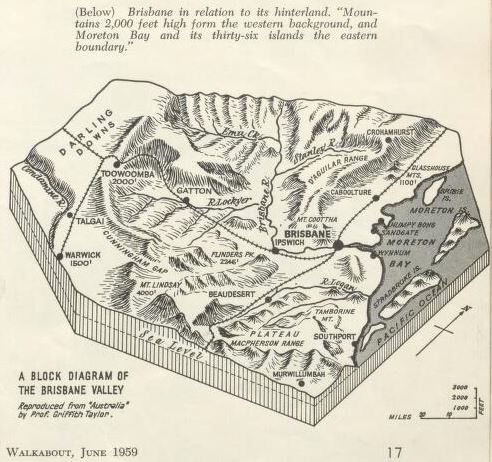
Brisbane region 1959

Bribie Island featured in a 
Block diagram of Brisbane region 1959

This year is 160 years since Queensland became the Colony of Queensland when it separated from the Colony of New South Wales in 1859.


Cover of Walkabout magazine
June 1959


Sixty years ago, in June 1959, the magazine Walkabout produced a souvenir issue to celebrate the centenary and courtesy of the National Library of Australia's wonderful online resource Trove, the souvenir magazine can be read online. 

Happy Birthday Queensland!


A Block Diagram of the Brisbane Valley.
Walkabout, June 1959, page 17
One of the illustrations shows a block diagram of the Brisbane Valley which provides a remarkable aerial view of Brisbane and surrounding country and Moreton Bay.

 As you can see Bribie Island is one of the islands depicted.

This block diagram had been previously published by Prof. Thomas Griffith Taylor in his book on Australia (7th ed., 1959, Fig. 61). 

Grif Taylor (1880-1963) was an English geographer, anthropologist and world explorer. He was a survivor of Captain Robert Scott's Terra Nova Expedition to Antarctica. 

REFERENCES
Taylor, T.G. (1959) Australia: a study of warm environments and their effect on British settlement. 7th ed. Fig. 61: A block diagram of the Brisbane Valley.

Walkabout Magazine (1934-1978) produced by the Australian National Travel Association available online via National Library of Australia's Trove https://nla.gov.au/nla.obj-566923190 

Saturday, 5 December 2015

Bribie Island's Most Historic House is 100 years old

BRIBIE ISLAND'S MOST HISTORIC HOUSE 100 YEARS OLD
Barry Clark- Founder Bribie Island Historical Society

Bribie Island Historical Society aims to raise awareness and interest in the rich history of Bribie Island.  Historians recognise that Bribie Island contains more history, written and unwritten, than any other place in Queensland.

Coungeau House 2015
The still grand Coungeau House today, raised up,
enclosed and wheelchair friendly.
Photo: Barry Clark
October 31st marked the Centenary of Bribie most Historic House, one of the first houses built in Bongaree, in Banya Street in 1915.  Although 216 years have passed since Mathew Flinders set the first white foot on Bribie Island, it is little more than 100 years since the Island became a destination for holiday makers and pioneer residents.

Building the Jetty, bringing Steamship excursions and making land available at Bongaree in 1912 was the start of it all.  Norm and Emily Coungeau were among the first to buy and build a house in Banya Street in 1915. They had both led interesting lives and ran a popular "Continental" Cafe in Brisbane for many years, visiting Bribie regularly, prior to moving to their retirement home here in 1919.
Coungeau House c1920-1930
Coungeau House, built 1915, when
Banya Street was just an overgrown sand track.
Photo: E. Gobolos

Their commercial success enabled them to become patrons of the Arts and donors to many charitable causes during their 20 years living in their Bribie Home.  As old age and ill health came upon them by 1936 during the great Depression, they decided to gift their magnificent home to the Church of England, and it was then used it as a retreat for Clergy and families for more than 40 years.

During the War years, when most Bribie residents were evacuated, the house was occupied by the American and later the Australian Commander of the Toorbul Point Military Training Camp,located on the site of the new Sandstone Point Hotel.

In the 1970s the House was sold to the Toc-H organisation who have since then made the house available to people in need and with disabilities to stay, and many local groups to use the hall underneath. Toc-H was itself established 100 years ago in 1915, in the heat of WW1 battles in Belgium, by an Australian Chaplain "Tubby" Clayton.  On the last weekend in October 2015 the Bribie Historical Society hosted a significant event to celebrate and recognise 100 years years of both Coungeau House, and the Toc-H movement.

REFLECTING 100 YEARS ON BRIBIE

Attended by 120 invited guests, including many long term Bribie residents and people with personal connections to Banya Street, plus representatives of many   Community and Service Groups and supporters or users of the Toc-H facilities. Many of the guests dressed in period costume which added greatly to the atmosphere of the event, taking people on a fascinating journey through 100 years of local history.

The commemorative programme for the event had been designed to capture the spirit of this special "home" used by a variety of people over the years.  Barry Clark, founder of the Historical Society, welcome the assembled crowd, many of whom had taken a tour of the old house in their splendid costumes.  During the course of the afternoon he introduced many special guests in the context of their historical connection with the House and the Street.

The original owner Emily Coungeau had been a prolific Poet and Libretist and Jenda Jacobs Voices Choral Group began the entertainment by singing one of Emilys songs titled "Aurelle" to convey the style of her writing. The long term caretaker of the Coungeau House, Jan Cleaver, recited one of Emily's 1919 poems, written in the house, titled "Evening at Bribie Island".
Centenary Celebration Team
Rear L-R: Jenda Jacobs, Ray Geise, Lynne Hooper.
Front: Barry and Faye Clark
Photo: Barry Clark

Recently elected Historical Society President Lynne Hooper gave a comprehensive presentation on the life of the Coungeau's, showing many historic photos and documents that captured the remarkable life of these significant, but little recognised, Bribie Islanders and the community in which they lived..

Barry Clark reflected on the War years on Bribie with stories of its military occupation by both American and Australian officers, when there had been a large Training Camp on the site that is now the new Sandstone Point Hotel.  He then introduced a very special guest, Gretel (nee Gehrmann) Quin, who had been a tiny new born baby living at Coungeau House in 1944 with her mother Gabrielle and father Lt.Col. August (Gus) Gehrmann.

PIONEER BRIBIE FAMILIES REPRESENTED

Another special guest was Mike Harris who had contacted the Historical Society with a wonderful story of his Grandmother, Nan Bowles who had lived at Poverty Point on an Oyster lease with her family as a small girl in the 1890s.  Other long term Bribie families from the 1940s and 1950s included the Kling family who ran the Bakery, Tesch who operated the Cinema, Winston who had the Store and grew Tobacco, Sked who had been Postmaster, Hammond who built an Ice works, and Mullen who was the pharmacist.

A few very special people from the 1920s and 1930s had been invited, but due to ill health were unable to attend. These included Dorothy Shirley, Joyce Voysey, Jaquie Hammond and Jean Britnell, whose mother Bobby Britnell was a founding member of Toc-H on Bribie, and her father was manager of the Bribie Island Bowls Club after the war. Other important residents from the 1960s and 1970s unable to attend were Ted Clayton, and historian author Warwick Outram.

During the course of the afternoon the audience enjoyed a moving experience covering 100 years of island history.  The event concluded with an informative presentation by Ray Geise OAM ,Director of Toc-H Australia, outlining the history the movement from its founding in 1915, and the significance of Coungeau House as the only property owned by Toc-H in Queeensland.

The afternoon ended with everyone singing a unique Coungeau House version of "This Old House" led by the Voices Choral Group.  Food and drink was sponsored by Busy Fingers and MBRC and there was much excited conversation as new and old friends reflected on what they had heard.

Organisers were very pleased with the event, recognising the importance of showcasing local history and paying tribute to some important "characters" who made Bribie what it is today, and whose contribution is often forgotten.  Historical Society founder Barry Clark said "There is clearly a growing interest in Bribie's rich history, and to appreciate the people, places and events that took place here just a generation ago. Only a few of these special people are still with us today, so we must respect their contribution and capture their stories before they are lost forever. The commercial future of Bribie Island may well lie in effectively showcasing this history as one of our main attractions".


Bribie's Coungeau House 100 years old

BRIBIE'S COUNGEAU HOUSE -100 YEARS OLD.
Barry Clark- Founder Bribie Island Historical Society

October 31st marked the Centenary of Bribie Island's most historic building, which once again created an opportunity for the Bribie Island Historical Society to showcase the rich history of the Island.

Coungeau House 2015
Coungeau House today, raised up, enclosed and wheelchair friendly.
Photo: Barry Clark
Coungeau House at No. 36 Banya Street was one of the first houses built in Bongaree in 1915 when the island had just become a destination for holiday makers and pioneer residents.  Building the Jetty, bringing Steamship excursions and making land available at Bongaree in 1912 was the start of it all.
Coungeau House c1920-1930
Coungeau House built in Banya Street in 1915.
Photo: E. Gobolos

Emily and Norm Coungeau had both led interesting lives and ran a popular "Continental" Cafe in Brisbane for many years, visiting Bribie frequently by steamship before to moving to their magnificent retirement home here in 1919.  Business success had enabled them to become patrons of the Arts and donors to many charitable causes. Emily was a prolific writer of poems and songs, many of which were published around the world. Indeed she wrote the words of Australia's first Opera.

UNIQUE LIFESTYLE ON BRIBIE ISLAND

They lived a relaxed social life here for 20 years as participants in many aspects of the small community, when the resident population was only about 50 and the holiday visitors numbered in the thousands.  Holiday makers camped in canvas tents along the foreshore, but several Guest houses started up on the island, especially in Banya Street.  Today it is a divided and tree lined road, but in those early days it was just an overgrown sand track, and a long hard walk carrying a suitcase from the Jetty.  Life on Bribie was very special, far away from city life and creating a unique and close knit community.

As old age and ill health caught up with them by 1936, during the great Depression, they decided to gift their magnificent home to the Church of England, when it became a holiday retreat for Clergy and families for the next 40 years.

During the 1940s War years most Bribie residents were evacuated, and the house was occupied by American and Australian Commanders of the Toorbul Point Military Training Camp, located on the site of the new Sandstone Point Hotel.

In the 1970's the House was sold to the Toc-H movement who make it available for people in need and with disabilities to stay, and many local groups to use the hall underneath.  The Toc-H movement was itself established 100 years ago in 1915, in the heat of WW1 battles in Belgium, by an Australian Chaplain "Tubby" Clayton.

On October 31st 2015, the Bribie Historical Society hosted a significant event to celebrate and recognise 100 years years of both Coungeau House, and the Toc-H movement.


TWO CENTENARY EVENTS CELEBRATED

Centenary Team
Rear L to R: Jenda Jacobs, Ray Geise, Lynne Hooper.
Front: Barry and Faye Clark
Photo: Barry Clark
Many long term Bribie residents, with personal connections to Banya Street, and representatives of local Community and Service Groups were invited to celebrate the Centenary. Over 120 invited guests, many dressed in period costume adding greatly to the atmosphere of the event, were taken on a fascinating journey through 100 years of local history.  The  programme for the event had been designed to capture the spirit of this special "home" used by a variety of people over the years.

Barry Clark, founder of the Historical Society, welcome the assembled crowd, many of whom had taken a tour of the old house in their splendid costumes. Jenda Jacobs and her Voices Choral Group began the afternoon singing one of Emilys songs titled "Aurelle" to convey the style of her writing. The long term caretaker of Coungeau House, Jan Cleaver, recited one of Emily's poems written in the house in 1919, titled "Evening at Bribie Island". Guests were surprised to learn of such rich culture existing on little old Bribie island.

Historical Society President Lynne Hooper gave a very well researched presentation on the life of the Coungeau's, showing historic photos and documents capturing the remarkable life of these important, but little recognised early residents, and the community in which they lived.

Barry Clark reflected on the War years on Bribie with stories of its military occupation by both American and Australian officers and the challenges faced during those dark days of WW2.  He then introduced a very special guest, Gretel (nee Gehrmann) Quin, who had been a tiny new born baby living at Coungeau House in 1944 with her mother Gabrielle and father Lt.Col. August (Gus) Gehrmann who was the Training Camp Commander. She had not been back since those days.

SPECIAL GUESTS INVITED

Another special guest was Mike Harris whose wonderful story about his Grandmother, Nan Bowles, living on Bribie as a small girl in the 1890s was published in last month's Bribie Islander.

Barry, Theresa and Mike Harris
Barry Clark with Theresa and Mike Harris,
whose Grandmother's story was published last month.
Photo: Barry Clark
Other long term Bribie families representing the early days were the Kling's who ran the Bakery, Tesch who operated the Cinema, Winston who had the Store, Sked who had been Postmaster, and Mullen who had the pharmacy.  Apologies had been received from much respected early residents and community leaders including Dorothy Shirley, Joyce Voysey, Jaquie Hammond, Jean Britnell, Ted Clayton, and historian author Warwick Outram.

The event concluded with an informative presentation by Ray Geise OAM, Director of Toc-H Australia, outlining the history the movement from its founding in 1915, and the significance of Coungeau House as the only property owned by Toc-H in Queeensland.

A commemorative bronze plaque was presented by the Bribie Island Rotary Club to record the Centenary, and 110 years of Rotary International. The plaque will be mounted on the outside of the building as a visible reminder of its history.

Rotary Plaque Commemorating 100 years
Rotary President Mary Grant presents plaque
to Toc-H Director Ray Geise
Photo: Barry Clark
The Bribi Island Historical Society presented a framed photo of Coungeau House in the 1920s, to be hung in the house as a reminder to visitors of its historic significance.

The crowd enjoyed fine food and drink afterwards sponsored by Busy Fingers and old and new friends enjoyed lively conversation.  Historical Society founder Barry Clark reflected on the successful event and said "There is clearly a growing interest in Bribie's rich history, and to appreciate the people, places and events that took place here just a generation ago. Only a few of these special people are still with us today, so we must respect their contribution and capture their stories before they are lost forever. The commercial future of Bribie Island may well lie in effectively showcasing this history as one of our main attractions".

Sunday, 1 November 2015

Wow, that's me in that old photo! Ron Jennings, then and now.


WOW....THAT'S ME IN THAT OLD PHOTO !

Ron Jennings and Family, 2015.
Ron Jennings shows his old photo to his family
(L to R) Libby, Andrew and daughter-in-law Sherryl.
Photo source: Barry Clark
This is a delightful story of a man being surprised to see a photo of himself taken 72 years ago, and being reminded of a memorable Christmas past.

Ron Jennings grew up in country Victoria and as a young man was keen to join the Army and serve his country. He joined the Army in 1942 at age 17 spent a short time at the Military Training Camp at Toorbul Point, the site of what is now the new Sandstone Point Hotel.

Last week he was taken to the Hotel by his family and looked at the many historic photos on display....when he suddenly spotted himself in one of the photos.


Toorbul Point Hospital, 1943.
Photo taken Christmas 1943 in the Field Hospital.
Ron Jennings is fourth along on the left.
Photo source: MBRC Library P2167
It was taken in a 12 bed Military Field Hospital in December 1943, which had stood right where the main bar of the new Hotel is today, and where Ron Jennings saw it for the first time on his visit to Bribie last week ......73 years later.

Vivid memories filled his head as he recalled the events that led to his being in the Military Field Hospital at Christmas-time all those years ago.

In an interview with Barry Clark of the Bribie Island Historical Society, who had supplied the photo for display at the Hotel, he said ....

  "It was a rather strange occurrence that happened. We were camped on the flat below the hospital, close to the spot  where the old Boat Shed and Jetty still stand today. A few days before Christmas six of us got leave to go to a dance at Cooroy on the weekend.

We went on the Saturday morning and were booked at the local Hotel for the night. We had a good time at the dance, but in the morning one of the boys, Bluey Copeland, who had red hair and lots of freckles, was really ill. I was able to arrange a truck from camp to pick myself and Bluey up at the Railway station. It was at Landsborough I think.

Anyway, Bluey was delivered to the camp hospital and for some reason I was invited to join some of the other patients for a very nice lunch. You can even see Christmas decorations strung up in the photo, and bottles of beer on the table.  They suspected that Bluey had Dengue fever, but I don't know what happened to him because I didn't stay much longer.

Within a couple of days we had all our Beach Landing Craft ready, and we sailed away to fight the war in the islands. It was Christmas day when we set off north, and I never heard what happened to Bluey. 

I am amazed to see myself in that photos after all these years. I am the fourth one along on the left, just half a face, but I don't know who could have taken it.  I don't recognise anyone else in the photo, but it is just possible that Bluey is the guy in the bed in the background on the left.  I do remember enjoying their company that day, before I set off to the war with the Japanese in PNG.  I am sorry my memory is not so good these days."

Seeing the photo brought memories flooding back to Ron's head of how he had tried several times to join the Army, against his father's wishes. He had worked with the Post Office and eventually joined an Ordinance Corp. and after initial training in Wagga Wagga he found himself briefly at Toorbul Point Camp in 1943 before going to the islands with his Beach Landing Craft unit.

"We even had carrier pigeons in small cages on board our vessels for getting messages to each other, and we rubbed Kerosene on ourselves to protect from the fleas and mozzies. I had a bout of Malaria while we were up there, and experienced some very difficult situations landing people under fire on beaches near Milne Bay. I remember having my 21st birthday in Borneo. It just seems like so long ago now, but I was blessed with a great life after that, and a wonderful family."

Ron lost his wife of 66 years just a couple of years ago. Their five children, four boys and a girl, now live all around Australia but it is the family connection with Bribie Island that has led to this lovely story being uncovered.

Son Andrew and wife Libby had lived on Bribie some years ago, and another son Paul and his wife Sherryl live here today. It was their visit to the new Sandstone Point Hotel and connection with Barry Clark of the Bribie Island Historical Society that led to this fascinating discovery of a young soldier's face in a long forgotten photo.

If you have interesting old photos or special memories of Bribie Island contact them on bribiehistoricalsociety@gmail.com

Thursday, 8 October 2015

Coungeau House, Bribie's most historic house, Celebrating 100 years

. . . . .


An article on the current caretakers of Coungeau House, Jan and Bob Cleaver, by Brad Penfold, entitled A house of sanctuary for those in need, was published on the Toowoomba Chronicle webpages on 26 Dec 2104.  

Sunday, 4 October 2015

Nan's Story by Mike Harris

'Nan's' childhood on Bribie Island circa 1900

Reproduced from The Bribie Islander, October 2015, pages 34-35.

Inspired by the memories of his late Grandmother, Mike Harris contacted the Bribie Island Historical Society and has written the following account of his families time on Bribie as virtually the only residents between 1898 and 1908. 

These are Mike Harris's memories of his grandmother Florence Anne Gregg (nee Bowles) who he refers to as “Nan” in this story.

Mike Harris holds a photo of "Nan" who spent
her childhood on Bribie almost 120 years ago.

Photo source: Barry Clark
NAN'S STORY  by Mike Harris

Nan was born on 1st November 1894 and passed away on 9th February 1990, aged 95.

Her father William Bowles was born at Kangaroo Point, Brisbane on 25th June 1859, some months before the “Colony of Queensland” separated from New South Wales to become a State in its own right.

On 22 June 1889, Nan's father married her mother Anne Sigley, and they had 10 children. Soon afterwards, Nan's father who was a Fisherman and Oysterman, was offered the job of managing the Bribie Island oyster leases owned by James Clark, also known as “The Pearl King".

In 1898, when Florence (Nan) was just 4 years old, the whole family joined their father on Bribie Island, when his occupation was officially listed as “Oysterman”,  and when Oystering at Bribie Island was Queensland’s largest industry.

Nan and her family lived in a timber homestead somewhere in the vicinity of Poverty Point near the creek there.  At that time, there was only one other permanent settler living on the Island.

In spite of their isolation, it was still a very good life because Nan often spoke of the wonderful freedom and happiness, which she and her family enjoyed on the Island. They were all very happy, even though it may seem quite difficult by today’s standards.

The men toiled hard, working on the Clark Company’s oyster leases from dawn till dusk, six days a week, and the women cooked on wood stoves, washed the clothes by hand, and after dark, used Hurricane (kerosene) Lamps and Carbide (gas) Lamps as their only means of lighting.

Nevertheless, Nan and her sibling’s days were filled with wonder and great adventure as they explored the vast lonely beaches and dense bushland on the Island.   Nan boasted of the great fishing and how they caught large “Muddies” (Mud Crabs) in their dillies, and not the “nuisance Sandies” (Sand Crabs), which they tossed back.   What a wonderful privilege it must have been to have lived on the Island in those days, experiencing all of its natural beauty, untouched landscapes, pristine environments and eating the fresh and ever abundant seafood.

This photo from John Oxley Library, taken at Whitepatch,
shows the site of Bribie Town in 1910
.
Source of photo: John Oxley Library JOL_QSA_C59_732322
 A small group of Aborigines existed on Bribie Island in those days and Nan said they got on reasonably well with the new settlers.

I believe they were of the Djundubari Tribe, and the government had established an Reserve for them in 1877 at Whitepatch, but it did not last very long.

The boat that picked up the harvested oysters travelled up from Brisbane every fortnight.   Prior to the boat’s arrival, the workers would have the job of removing the oysters (left sealed in their shells) from the rocks, and storing them temporarily on a large movable platform that was lowered below the tide level to keep them alive, until they were ready to be packed for shipment.

 At packing time, the oysters were loaded into wooden boxes with wet sawdust around them to keep them moist, cool and fresh for the trip.   Packed in this manner, Nan said that the oysters would keep for at least 2 weeks for a trip to Melbourne.   The oysters were sent expressly for wealthy Dinner Tables and the “Well-to-do Restaurants” of the 1890’s in Melbourne.   In those days Melbourne was a rich and vibrant city made affluent by the enormous wealth derived from the Victorian Goldfields.   Nan said that the James Clark Oyster Company was a hive of activity just before the boat’s arrival, as they would raise the movable platform, remove the oysters, pack them into the boxes, and then cart them to the jetty, ready for shipment to Brisbane before being sent south.

Nan’s father died of a heart attack in 1908, which would make him only 49 years old at the time.   Nan believed his early death was caused by all the hard and exhausting work he did as a Fisherman and an Oysterman.   After his death, the whole family moved to Brisbane, into a house they purchased on River Terrace at Kangaroo Point.

Nan married my Grandfather Leo Thomas Gregg on 9th December 1916 at St Joseph’s Church, Kangaroo Point.  Following Leo’s death after 36 years of marriage in 1952, Nan and her younger sister Eileen returned annually to Bribie Island with other family members on “sentimental’ holidays”.  They rented a cottage at Number 6 Third Avenue, Bongaree.

On one such holiday in 1958, Nan and Eileen visited the location of the old James Clark Oyster Company leases, only to discover that their old timber homestead had collapsed and rotted away.   All that was left were the rusted remains of the wood stove that her mother had cooked on.   I remember Nan showing me those rusted scraps of cast-iron, which they brought back as souvenirs to Brisbane.   Such were their loving and happy memories of past times on Bribie Island that they brought home these little treasured keepsakes.

Over the years, Bribie Island has seen many changes.  I can still remember it way back in 1953, well before the bridge was built, whilst on holidays with Nan and other family members.  We caught the “SS Koopa” steamship to Bribie Island run from the Custom’s House Wharf in Queen Street, Brisbane.

Now, whenever I visit Bribie Island, I think of my Nan who lived there as a girl so happily but in such isolation over 117 years ago.   Every visit seems like a pilgrimage to a much Hallowed Place, to remember the past lives of Nan and her family and recall their wonderful and happy experiences as new settlers to the Island.
Mike Harris. Morningside. Queensland. 

What about your own family links to old Bribie Island ? If you have any interesting family connections or old photos of Bribie Island please contact the Historical Society on bribiehistoricalsociety@gmail.com  

Thursday, 24 September 2015

Welcome to the Bribie History Blog

At the September 2015 meeting of the Bribie Island Historical Society committee, it was agreed to set up the Bribie History Blog.

We will be bringing you fascinating articles of Bribie's history as well as providing information about upcoming events and access to our brochures and newsletters.

Our historical database thesaurus can be used to request information from the Society's database.

Welcome to our blog.

Friday, 4 September 2015

Bribie Library celebrates 50 years in 2014


Bribie Library celebrates 50 years’ service 

By Barry Clark, Bribie Island Historical Society   
   
Reproduced from the BRIBIE ISLANDER November 2014, p. 13.

Bribie Island Public Library is arguably the most used public facility in our community.  The building these days is modern spacious and well utilised but it started from very humble beginnings.   

The site where the library stands today was originally known as “The Hill”, being an elevated sand dune that ran beside swampy ground through what is now the bowling club and caravan park.  It was a popular vantage point in the early days of tourism through the 1920s and 1930s, where campers pitched their tents and crowds of visitors enjoyed picnics and games.  During the Second World War the site was used for fuel and water storage tanks and pumps.

The small shed that held the fledgling Bribie Island Library.
Photo source: State Library of Queensland, neg. no. 99974
After the war, a small wooden building on the site was used as an amenities and changing shed by visitors.  This shed was used in the period from 1956 to 1959 as a snack bar and fish & chip shop by Jim Looke, and then remained empty and largely unused for several years after that.

With a resident population of just a few hundred people at the time, nobody had seen the need for a public library on Bribie Island.

In 1963, just before the new Bribie Bridge opened, a large new hall was built in Cotterill Avenue as a roller skating rink and dance hall.  This building has had an interesting history over its fifty-year life, becoming a cinema for several years in the 1970s before television became popular, then as the Busy Fingers Op Shop for over twenty years, until it eventually became the Baptist Church as it is today.

It was in this brand new hall in 1961 that a group of local business people held the first meeting for the formation of a Bribie Island Chamber of Commerce.

The small but very active Bribie community was hopeful of establishing a civic centre with meeting rooms and a library.  This idea coincided with the return to Bribie Island in 1963 of a lady who would play a very significant role in the establishment and development of a public library.

Marguerite “Lou” Young had spent some time on Bribie Island during the war years at their family cottage named “Tolga”, when the military were in occupation and just a few civilian residents remained here.  In 1963 she came back to live on Bribie with her husband Ken and three children.  They established and ran “Bribie Welding Works” which continued for 28 years.

Lou Young soon became involved with the Bribie Island State School P&C where she reorganised the school library.  Lou had always been a self-confessed “Book Worm” but this task involved her first and only book burning, of old and battered books, and a request for funds to obtain new books for current students’ needs.  Although having few formal qualifications, Young was then asked by the local Police Sergeant to set up a public library, which she promptly did in the old wooden shed on The Hill.

This very basic library opened in the shed in 1964, with just 200 fiction books and 100 non-fiction books.  Lou’s mother, Mrs Farleigh was the very first member to sign up.  However, book borrowing was not very popular on Bribie in those days as only 19 members joined in the first three years.  Interestingly, records reveal that the island’s most famous resident and International recluse artist Ian Fairweather became library member number 23.

The many thousands of visitors and holiday-makers were keen readers and a second-hand book exchange was also available in the shed for those who were not eligible to be members of the official Caboolture Council Library.

The library continued to operate in this small shed for the next 16 years until 1976, when the Caboolture Council built a brand new modern brick library, just south of the shed.  Lou Young served as the librarian from inception, initially part time and then becoming the full time Council Librarian.

Bribie Island Library, circa 1976.
Photo source:  Don Mullen
The 1976 building is today’s southern end of the library complex housing the large Hector Holthouse room, used for exhibitions and functions, and the small John Bateman meeting room. 

Soon after the new library had opened an interesting weather event was captured in a photo taken by local Pharmacist Don Mullen, showing a white covering of hailstones on the ground and a rainbow arching over the new building.

In the first 20 years to 1984, membership of the Library grew to some 3800 members and over the following 30 years membership and usage grew to over 14,000 members today.  This dramatic increase in library services led to a major new extension to the library building in 2004.


The original old shed remained on the hill until 1992 when it was finally declared unsafe and demolished by the Council.  The granddaughter of Jim Looke, the fish & chip shop operator in the 1950s, sought to retain the shed as an item of Bribie history.  However, it was demolished. 

However, in recognition a small plaque was placed in a garden in front of the library entrance, which can still be seen today, paying tribute to Jim Looke’s business in the shed from 1956 to 1959.

Small plaque in front of Bribie Island Library, 2014.
The plaque is paying tribute to Jim Looke's business 1956-1959.
Photo source: Barry Clark.
The humble shed played a significant role in the development of the Bribie community, and its demolition in 1992 coincided with the retirement of Lou Young as librarian after 27 years of dedicated service.  Just prior to her retirement Lou Young compiled a document titled Bribie Island: a collection of information for students capturing many aspects of Bribie Island history.  She sought to document answers to the many thousands of questions she had been asked about Bribie Island over her many years of service.

The library building was significantly enlarged in 2004 with an extension on the northern end, which today houses all of the books and technology of the modern library services.

The current Librarian Bronwyn Ash and her exceptional staff invited the public to commemorate 50 years of service by the Bribie Island Library in December 2014.

WW1 Veterans at the 1978 ANZAC Day parade on Bribie Island

This photo was taken at the 1978 ANZAC Day parade on Bribie Island and shows a group of World War 1 Veterans.  From left to right: Eric Watson, Alf Duncanson, Ted Mawhinney, Roy Porter and Harold Braund.

One of our BIHS members recognised a family resemblance to his own Porter relatives in Roy Porter, the second man from the right.

Does anyone have further information on Roy Porter?

Roy Porter is the second man from the right.
Does anyone have further information on Roy Porter?
Source of photo: MBRC photo P1803